
Did you think that the Milky Way was created with the same mold as the other hundreds of billions of galaxies that exist?
Well the answer is no!
There are different types of galaxies in the known universe.
Not all galaxies are exactly the same; in fact, there are different types of galaxies , and they are classified according to their shape or the luminescence of their stars.
The study of the nature of galaxies is one of the most important research areas in modern astronomy.
Trying to understand their composition, behavior, formation process and even their interaction with each other is vital to begin to unveil all the secrets of our universe.
For thousands of years we thought that our solar system was all that existed, and that our planet was the center of what was thought to be divine creation.
Later we understood that we were very wrong; there are millions of stars just like our sun, many with entire planetary systems orbiting them… and our minds expanded.
Our galaxy (which seemed to be the entire universe) is huge and we are just a tiny part of it.
But as if that were not enough, then we discovered something else: Our galaxies, which already seemed to be endless, harboring all those stars and planets, no more than an insignificant point in the entire universal fabric.
There are hundreds of thousands of other galaxies throughout the Universe!
Our galaxy is breathtaking. If you want to learn everything about the Milky Way, simply click to read our article, "The Milky Way: How Much Do You Know About Our Galaxy?"
The conception about our existence changed forever: we are not just an insignificant point, we are an insignificant point within another insignificant point.
What a blow to our ego!
Discovery of the different types of galaxies
Since the invention of the first telescope in 1606, we have only just begun to understand the impressive complexity of the universe and its colossal dimensions. We understood that our solar system is not unique, that there are billions of the same within our galaxy, but that did not stop there.
For hundreds of years we thought that our galaxy was all there was, we believed that the universe ended at the limits of the Milky Way. Nothing further from reality.
It wasn't until 1923 that the legendary astronomer, Edwin Hubble, began to notice something strange about what appeared to be a very distant star cluster.
Thanks to calculations based on the relationship between luminosity and distance (taking into account the rhythm of the light pulses emitted by stars), he made a discovery that would completely revolutionize our understanding of the universe: This group of stars was outside the boundaries of our galaxy.
The discovery led to a single conclusion: Our galaxy did not represent the entire extent of the universe, but: How many galaxies exist then?
The group of stars discovered by Hubble outside our galaxy turned out to be what we now know as Andromeda, our nearest neighboring galaxy, just 2.5 light-years away.
Another interesting fact is that Andromeda didn't appear to be completely identical to the Milky Way, our galaxy (although they have often been called " twin galaxies "). This raised another important question: are there different types of galaxies in the universe?
Since that point, almost 100 years ago, many astronomers and astrophysicists have devoted themselves entirely to identifying and understanding what types of galaxies exist throughout the universe. The results are truly fascinating.
How we study the different types of galaxy
Yes, in 1923 we managed to see, for the first time, another neighboring galaxy, but from then on, delving into the study of other galaxies seemed to be almost impossible, at least for the tools available in the XNUMXth century.
However, things changed from 1990 onwards, when NASA put the Hubble super space telescope into orbit.
This one, unlike its predecessors, is equipped with special lenses, sensitive to infrared and ultraviolet light emissions and to impulses caused by X-ray and Gamma-ray emissions, both as a result of nuclear fusion on the surface of many stars. .
What did Hubble show us?
The Milky Way and Andromeda are not two orphaned sisters, wandering alone through the universe. In fact, they are the older sisters of a galactic cluster, made up of a total of 46 galaxies, which in turn represents a microscopic part of a galactic " supercluster ," formed by more than 5.000 different galaxies.
The key word here was “Different”.
With so many samples to study, scientists learned that not all galaxies are the same, and many don't even resemble each other as much as the Milky Way and Andromeda (both are spiral galaxies).
Then, at the end of the 20th century, a question arose that would define astronomical research in later years: How many types of galaxies are there and what are they?
Hubble Sequence: This is how galaxies are measured

Hubble sequence to graph the different types of galaxy according to their shape
After the revolutionary discovery of the Andromeda Galaxy in 1923, Edwin Hubble dedicated himself to learning about the different types of galaxies that exist and developing a method to classify them.
From there was born what we know today as the Hubble sequence or also tuning fork diagram, which is its real name.
This sequence encompasses the different types of galaxies that exist according to the shape they present as a result of the arrangement of the matter inside them, especially the clusters of cosmic gases and stardust.
In addition, each category according to shape is further divided into subcategories according to the arrangement of its mass, diameter, and luminosity.
- Spiral galaxies
- Regular
- barred spirals
- intermediate spiral
- Elliptical galaxies
- square ellipticals
- discoidal ellipticals
- Irregular galaxies

Types of galaxies according to their shape
Galaxies are made up mostly of stardust, which orbits along with stars, planets and other cosmic objects around the galactic center (which is usually a black hole).
The point is that the arrangement of the bodies of the galaxy around the nucleus can take various forms, hence the different types of galaxies that we have in our classification are created.
There are three main types of galaxies according to their shape: Elliptical, Spiral and Lenticular.
A fourth category has also been recently added: Irregular Galaxies. The different types of galaxies that do not match the characteristics of the other classifications fall into this category.
Let's see what this is about:
Elliptical Galaxies
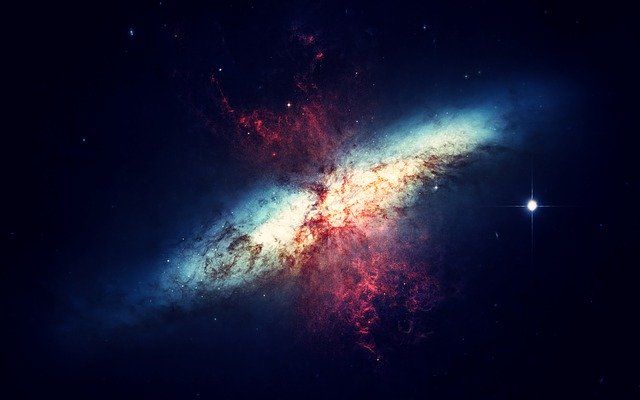
Elliptical types of galaxies are very abundant in our universe. They can be much more imposing than massive spiral galaxies, since the largest elliptical galaxies are the result of multiple collisions of smaller galaxies over millions of years.
Because of this, elliptical galaxies show a flat, oval shape, like an ellipse (hence their name), but there is no noticeable ordered behavior in the elements that compose it.
In these galaxies, the stars, planets, planetoids, dust clouds and asteroids orbit in a disorganized way, without following an apparent gravitational pattern (as occurs with spiral galaxies), so their structure is poorly defined.
Elliptical galaxies are characterized by being made up -mostly- of old and massive stars, and by presenting considerably low concentrations of stellar dust, therefore, it is estimated that their rate of birth of new stars is very low, almost nil.
Spiral Galaxies

Spiral galaxies, like our Milky Way, have a much more defined body shape than elliptical galaxies. In this case, all the galactic mass rotates in an orderly way around the galactic nucleus.
The galactic nucleus or bulge can measure several light years in diameter and is mainly made up of a dense cluster of massive stars, so the highest rate of luminosity is present in its central part.
However, if we look further towards the center we find something very important, the massive stars of the bulge usually revolve around a much denser point of matter: a black hole, which gives off all the gravitational force that dominates the entire galaxy.
For example, our galaxy is dominated by a supermassive black hole called Sagittarius A.
Moving further from the center of the galaxy, we find the disk. The disk contains most of the body of spiral galaxies and is made up of most of the stars, planets, and interstellar dust.
The rotation of the clusters of matter in the disk around the gravitational center causes it to form several eccentric arms, giving it its well-known spiral shape.
Our galaxy, for example, is made up of 2 known major arms: Shield Centaurus, Perseus, and by various branches of lower density: Salient of Orion, Sagittarius, and Norma.
Spiral galaxies can be classified from S01 to S07 according to the degree of eccentricity of their arms. The more open the arms are with respect to the center of the galaxy, the higher their rank in the ranking.
Lenticular galaxies
The galaxies cataloged as lenticular today are thought to lie at some point of transition between elliptical and spiral galaxies. Despite being disk-shaped and showing signs of having had arms, the loss of their interstellar matter has erased them.
As its arms do not have any degree of eccentricity, its classification on the Hubble scale is S0.
Irregular galaxies are rich in interstellar dust clouds and young, dwarf stars. They are also a very slim classification, only 3% of observable galaxies can fall into the classification of lenticular galaxies.
What types of galaxies can lenticular galaxies become?
Lenticular galaxies are thought to be simply spiral galaxies that have not yet reached a point of maturity or accumulation of enough matter to take on the typical spiral shape.
As more matter accumulates, its arms expand in size, moving away from the gravitational center and acquiring a typical spiral shape that can be classified from S01 to s07.
Irregular galaxies
Irregular galaxies are simply a mystery to modern astronomy and fall into one classification because they do not fit well into other classifications in the Hubble sequence.
These types of irregular galaxies do not seem to present a defined structure in the distribution of their matter; they are not elliptical and spiral.
All the matter in the galaxy is simply piled up in a disturbance of space, not spinning around a definite gravitational point, nor do they show any apparent system or order. They usually have completely irregular shapes, like luminous spots in space.
They are made up of a variety of elements: asteroids, large amounts of gas and dust, and young and small stars, for the most part.

Other classifications of galaxies that exist in the universe
The types of galaxies are not only classified based on the distribution of their matter, they are also classified according to the amount and type of radiation they emit into space.
Galaxies that produce enough energy to emit large portions of electromagnetic radiation outwards are called Active Galaxies.
The galaxies that fall within this classification do not emit electromagnetic waves from the regular elements of a galaxy (stardust, stars and planets), but from extraordinary processes, which generally originate in the galactic nucleus.
These galaxies have something called Active Galactic Nucleus (AGN).

AGNs are thought to be produced when large concentrations of dust or material are sucked into the black hole that dominates the center of the galaxy.
Due to the high rates of gravitational magnetism that produce super friction, the matter is heated at a high rate, immediately turning into plasma, which generates powerful magnetic fields that are expelled outside the galaxy.
Not all galaxies are capable of generating this phenomenon for various reasons. In fact, only 10% of the galaxies observable from Earth are capable of generating this physical phenomenon.
There are different types of active galaxies according to the amount and type of energy they release to the outside.
Seyfert Galaxy
They are generally spiral galaxies with a very bright nucleus and a large amount of hyper-concentrated mass in the center.
As interstellar matter falls into the black hole, it generates spectral emission lines, mainly made up of hydrogen, helium, and carbon atoms.
starburst galaxy
Starbursts are types of galaxies that do not generate electromagnetic fields as a result of particle jets emitted from the Active Galactic Nucleus.
In this case, the energy released is produced as a result of multiple simultaneous starbursts. This means that these are galaxies with a much higher rate of new star formation than the average in other galaxies, which releases a greater amount of energy into outer space.
Stellar winds drag part of the excess concentration of hydrogen molecules, forming high-energy electromagnetic fields that are expelled from the center of the galaxy into space.
