
In this writing we will tell you about the artwork The Persistence of Memory , which is a work by the Spanish painter Salvador Dalí painted in 1931, also known as the soft or melting clocks.

The Persistence of Memory Salvador Dalí
Salvador Domingo Felipe Jacinto Doménech or simply Salvador Dalí, was a Spanish painter, sculptor, engraver, set designer and writer, son of a famous notary from Figueres. And one of the greatest representatives of surrealism (20/05/1904) in Figueiras, province of Girona, very close to the border with France.
The death of his brother affected the artist a lot, since he saw himself as the reincarnation of his brother. It is said that as a child he was a very spoiled child. He entered the world of painting at the early age of 12. Another very strong blow for him was the death of his mother from cancer.
As an artist he was very imaginative, since in his works he showed a tendency to narcissism and megalomania, what he did was attract more public attention. In an interview he came to describe himself as "a person too intelligent to be a good painter."
One of his most well-known works is The Persistence of Memory, also known as The Soft Watches or Melting Clocks. This painting was created using oil on canvas in the Surrealist style. Surrealism is an artistic movement that originated in literature and grants great creative freedom to those who employ it in their works, as it moves away from formalism and seeks the unconscious, escaping from reality. To learn more about this topic, you can visit art theory.

The objective of surrealism is to show the reality that others do not see, a reality that is in the unconscious or dreams.
One of the characteristics of Surrealism:
- In it, objects, feelings and concepts are mixed that in reality have no reason to exist.
- The forms that are applied in surrealist works will not have a traditional meaning.
- Wrong forms of things or objects are created that make them understandable in different ways.
- Surrealist artists give importance to destruction, mystery and absurdity.
- Surrealist works are critical of modern life.
- Imagination is an essential part of surrealism.
The Persistence of Memory was painted in 1931 using oil on canvas in a surrealist style. This painting measures only 24 cm x 33 cm, the size of a sheet of paper. It was created when he was 28 years old. It represents the fear of the passage of time.
It is said that this painting was made one day that Dalí and his wife were going to the cinema with their friends after eating. And he himself suffered a severe headache and decided to stay at his house. And at that time, waiting for his headache to go away on the terrace of his house, he noticed that the Camembert cheese was melting in the sun and from there he took the inspiration for this work of the persistence of memory.
Analysis of the work
Many analyzes can be done on this specific work and perhaps you can reach other conclusions regarding what he wants to raise in it.
The watch
The analyzes of experts in the arts who have experience in this, explain that the clocks that appear in the work represent the possibility that at some point in life it comes to an end. Another aspect to take into account is that all the clocks show 6 pm and that alludes to Albert Einstein's theory of relativity (1905).
It also shows us a subjective vision of temporality and its implications. And it also pays homage to the time inside the subconscious, that is, when we are asleep. Another issue to note in the case of watches is that they are recurrent in different works throughout his life.
As for the cast clocks, we can say that he wanted us to understand that time is not static but that it changes as time goes by. And that it is up to us to know how to use this time in our favor. Giving us more or less time in our activities.
Landscape
It is a large cliff that belongs to Port Lligat, which is a small town in the Mediterranean where I came to live.
The ants
Here it is said that Salvador Dalí had an aversion to ants. As for the clock that is upside down on the left full of ants, it is said to be a symbol of death and decay.
Self Portrait
The figure seen lying down with a melting clock on top is a caricature of Salvador Dalí himself. If you look closely at the work you can realize that there are eyebrows, an eye, an eyelash, a nose. I use this same figure in several of his previous works. This figure makes it seem that he is sleeping or immersed in a dream. In this case, the figure with the clock above it means that at the time of the dream, the time is different from that of reality.
And that is why when we are asleep and we are dreaming we can think that their time is different from reality.
Among the best works of Salvador Dalí
- Christ of Saint John of the Cross 1951.
- The temptation of San Antonio 1946.
- Dream Caused by the flight of a bee around a pomegranate one second before waking up 1944.
- Swans that are reflected as elephants 1937.
- Geopolitical child watching the birth of the new man 1943.
- The last supper 1955.
- The Madonna of Port Lligat 1950.
- Giraffe Burning 1937
- The Metamorphosis of Narcissus 1937.
- The Persistence of Memory 1931.
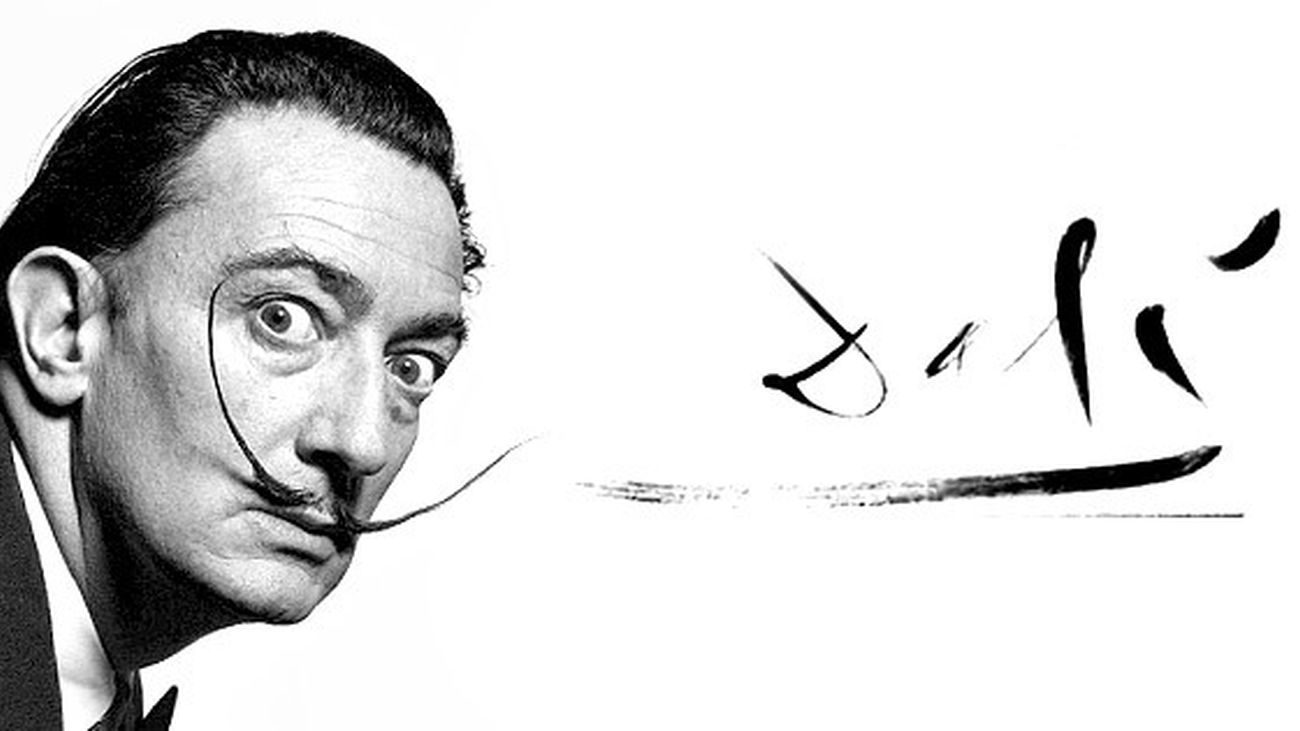
Salvador Dalí was an extremely eccentric artist, it is said that part of his eccentricity was invented by himself to have a greater exposure of his works. He himself wrote at the young age of 15 in his diary «that he would be a genius and the world would admire me. I may be despised and misunderstood but I will be a genius. And without the slightest doubt he succeeded.
He was a person who liked to break barriers in all areas of his life and therefore he was an extremely ambitious person and he promoted himself like no other could have done.
Salvador Dalí left an artistic legacy of fifteen hundred works including paintings, film collaborations, furniture, sculptures, and fashion design. Since his career spans more than six decades. And still many of his works are exhibited in different art galleries around the world.
Some anecdotes and curiosities about his life
- Salvador Dalí had an obsession with eggs since for him they represented hope and love. In the Dalí museum in Figueres you can see them inside his building, as he also had them in his house in Port Lligat.
- At a conference in London he appeared dressed in a diving suit.
- He was twice expelled from art school.
- In 1946 he worked with Roy E. Disney, Walt Disney's nephew, when he produced a short film called Destino.
- I also work as a fashion designer.
- Jewelry design.
- I illustrate a copy of the book Alice in Wonderland.
- He built his own museum and was buried in it.
It is said that the author of Persistence of Memory died on January 23, 1989 in Figueres at the age of 84 due to cardiac arrest.
Famous phrases the author of The Persistence of Memory
- Intelligence without ambition is a bird without wings.
- A painting is a photograph made by hand.
- Just because I don't know the meaning of my art doesn't mean I don't have it.
- If I die, I won't die at all.
- Time is one of the most important things we have left.
The Persistence of Memory is currently in the Museum of Modern Art in New York (MOMA) since it arrived in 1934, and will continue to make history for many decades.