
The symbols of Christianity are all those signs through which Christian doctrine is represented. Some of these have been used since the beginning of time, even within religions other than Christianity, remaining in use for many centuries.
symbols of christianity
The symbols of Christianity, also called Christian symbols, have been incorporated into the concepts that refer to the principles contained within the beliefs upon which the Christian religion is based. If you want to learn about other important symbols throughout history, you can read about Buddhist symbols.
These symbols of Christianity have served to preserve the foundations of Christ 's faith . During the Roman Empire, these symbols were used with some caution through a nascent religious syncretism that emerged at that time.
The Christian disciples had established themselves in two groups, the listeners who attended the assemblies, and who expressed their desire to be initiated into the faith. However, the environment lent itself to sneak in an informant, which delayed the baptisms of those interested in being part of the Christian community.
There were certain rituals that were reserved exclusively for the participation of those who entered into the doctrine of Christianity, especially those who became part of the so-called mystery of the flesh and blood of the Word of God.
It was then that the symbols of Christianity were created, as a strategy for initiates to distinguish themselves from the rest of the population and to make it easy to recognize each other.

Origin
Some symbols of Christianity could have their origin of existence within ancient mythology, where the image of part of the flora and fauna began to be used, which took a representative meaning of religion by itself, such as, for example, the Cross , the Peacock, the white dove, the fish, the palm, among others.
In religious contexts, the resurrection of Jesus was specifically represented by the figure of the turkey, and sometimes by the phoenix . The dove, for its part, symbolized simplicity, but also represented peace and purity of souls. Deer were considered servants of Christ.
One of the Christian symbols considered a universal religious icon is the fish, which by the time of the 13th century BC was taken as a type of ancient symbol, through which the resurrection of the dead was signified, used for the first time in that context, in the tomb of the Egyptian Khabekhnet , who was part of the 19th dynasty.
Just as in the times of Emperor Diocletian , when the Christian people lived through one of the most terrible persecutions in the 2nd and 3rd centuries AD, the Christian community took precautions against reliving something similar, so they disguised the use of Christian symbols, as was the case with the figure of the anchor, which is said to have been used to refer in a simulated way to the Cross of Christ.
The precise date when the Greek term ikhthys, which means fish, began to mean " Jesus Christ, Son of God and Savior " is unknown, but after his worldwide recognition, the figure of the fish came to be taken as a natural Christian symbol.
It was after the 3rd century that Christian symbols began to be used more openly, among them the representative image of the crucifixion of Jesus with his twelve disciples, and whose date is specified as between the 3rd or 4th centuries AD.
Over time, more symbols of Christianity were added, resulting in a wide range of them today, with the use of the Holy Cross standing out as a reminder of Christ 's crucifixion.
Even the image of the Virgin Mary, in all her advocations, embodies maternal love, an ideal reinforced in the mind by the strategic use of blue and white, colors with their own symbolism of celestial purity. Conversely, the use of horns and a tail automatically suggests a diabolical symbolism, associated with Satan, which is likewise reinforced by the use of fiery red.
Many of the first symbols linked to religion, became known icons with the same meaning worldwide, because for Christian doctrine, it was very important that they were created in that way and be easier for people to identify, regardless of the different cultures.
The lamb and the good shepherd are another example; the former represents the sacrifice of our savior, and the latter serves to conceptualize one of the most important characteristics of Christ himself. Other symbols include Noah 's Ark , the structure of churches, bread and wine, the Bible, and so on.

It is said that, in times of Christian persecution, the catacombs, which were a kind of underground cemetery, were used as refuges for these religious groups, a theory that was later questioned during the modern era. Apart from being seen as cemeteries, they also came to represent the martyrs through them, and even several sacraments were celebrated to pay homage to them.
The catacombs were the places for the rest of the souls that awaited their time awaiting the resurrection. The same painting with which they were decorated, were containing symbols and signs that denoted the existence of life after life and the commemoration of the Eucharist.
Many of the symbols of Christianity were taken as part of Christian art, which was shaped as an adornment of various religious structures, finding in these spaces a place to exhibit their creations and various achievements, coming to form some six hundred kilometers of underground galleries. , which are visited by tourists and pilgrims.
Types of Christianity Symbols
There are many representations and icons belonging to Christian doctrine that are categorized as symbols of Christianity. Other types of religious symbols that may be of interest to you include the five-pointed star.
Here are some of the most well-known symbols of Christianity:
Alpha and Omega
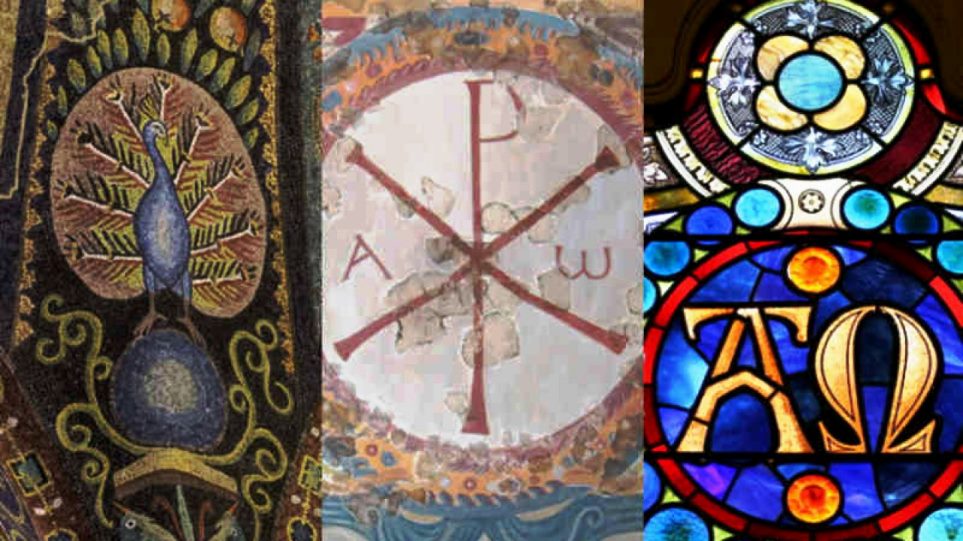
The Christian symbols Alpha and Omega are represented by the letters α or Α and ω or Ω , respectively, being the first and last letters of the Greek alphabet. According to this concept, they can be associated with beginning and end, representing the eternity of the Heavenly Father.

Similarly, within the holy scriptures, specifically in the gospel of John, two biblical passages from the book of Revelation are cited, where the Alpha and the Omega are named, one of them being the quote from Revelation 1:8.
These symbols of Christianity began to be used from the 4th century onwards, sometimes in combination with other symbols, one of which is the Chi-Rho monogram . They are among the most widely used symbols in Western churches, despite being letters of Greek origin.
Anchor
The anchor is another of the symbols of Christianity, which is identified with Security. In its beginnings, it was used as a symbol to represent hope, by the ancient believers of the faith, that hope that they had to preserve in the resurrection and in the future life that awaited after earthly life, the offered paradise.
It maintains a close relationship with the ichthys or fish symbol of Jesus , which is why it is very common to see them together in various images. During the times of persecution of Christians, the anchor symbol was used to disguise the symbol of the Cross of Jesus.

Crown of thorns
The Crown of Thorns is one of the symbols of Christianity that embodies the passion of Jesus Christ , because in those days, the Roman soldiers used it with the intention of humiliating him before being crucified, baptizing him as "the king of the Jews", according to the holy scriptures.
The biblical quote from the Gospel according to Saint John 19:2 expresses it clearly at the moment when these soldiers placed on Jesus' head a crown of thorns that they themselves had made.
Chrismon
Within the range of symbols of Christianity, the so-called "Christograms" were created, the Chi-Rho being part of one of them, also called Chi-Rho. It was formed from the two initial letters of the Greek name " Christ" or ΧΡΙΣΤΟΣ, which are the letters Chi (X) and Rho (P).
In the time of Constantine I, an emperor in Roman history, this symbol was used as a standard during the course of the 4th century AD. This symbol usually appears accompanied by the initials of Alpha and Omega.
During the pre-Christian era, this symbol was used with the term "chreston", which means useful. It was used as an abbreviation that was written to highlight interesting passages within the margins, to let them identify it.

the christian cross
The Christian cross is one of the most relevant symbols of Christianity. It represents the placement of two lines perpendicularly that then intersect. It symbolizes the place where the Messiah died.
Due to its close association with executions at the time, this symbol was not used by the Christian community; instead, the ichthys was more commonly used . The cross began to be linked to Christian doctrine from the 2nd and 3rd centuries onwards.
However, before there was talk of Christianity as a religion, the cross had already been used by other cultures, but with variations in its shape and other religious meanings, different from those it would later adopt. The Egyptian culture and the Hindu were some.
Within the various branches of Christianity, there are a variety of Christian crosses, the most well-known and widely used by the Catholic Church being the "Latin cross." It consists of two lines, one visibly longer than the other. Some of the most relevant variations of this symbol are: the Greek cross; the papal cross; the patriarchal cross or Cross of Lorraine; the Cross of Lorraine; the tau cross; and the Christian ankh.
jerusalem cross
The Jerusalem Cross is one of the most historically significant symbols of religion, popularly known worldwide as the Holy Land Cross or the Crusader Cross. Its structure features a central cross, of Hellenic origin, with straight ends.
Crosses of this type are called potent crosses. Their form is completed by the addition of a smaller Greek cross, placed in each of the quadrants within the main cross. These are called "crosslets." Various interpretations surround the Jerusalem Cross , each giving rise to its own meaning.
One of the most compelling theories is that the main cross symbolizes Jesus Christ , while the four smaller crosses represent the four main evangelists of religious history. Another interpretation is that the five crosses together represent the five wounds of the crucified Christ .
Cross of Saint Peter or Inverted Cross
The Cross of Saint Peter has the same shape as the Christian cross, but in an inverted position. Its name and origin stem from the crucifixion of Saint Peter , who did not believe he deserved to die in the same way as his master, and therefore, he was placed upside down.
The Christian community has used the symbol of this cross to represent the value of humility. However, its use has been questioned and criticized because it is also a symbol used by devil worship groups to express their opposition to Christian doctrine.

staurogram
The staurogram is one of the symbols of Christianity, formed by two Greek letters: Tau (τ) and Rho (ρ) , which are abbreviations of the Greek words stauros (σταυρός) and stauroo (σταυρόω), meaning cross and crucify, respectively. This symbol is also known as the monogram or Tau-Rho.
In some of its graphic representations, it can be found accompanied by other symbols such as the Alpha and Omega . Before being used as a Christian symbol, it had already been employed since pre-Christian times. It was the first of the signs used to represent the crucifixion of Jesus, its use dating from the 4th to the 6th centuries AD, being replaced over time by the Chi-Rho symbol.
Ichtus or Ichthys
The ichtus consists of two arches that, when intertwined, form the shape of a fish. Etymologically, the term is written ἰχθύς , which means fish. When written with capital letters (ΙΧΘΥΣ), it acquires its own symbolism expressed through an acronym:
- Ι: what does it mean Jesus
- Χ: what does it mean Christ
- Θ: what does it mean God
- Υ: what does it mean Son
- Σ: what does it mean Salvador
In the days when the doctrine of Christianity began, this symbol was used in secret. The figure of the fish has been recurrent within the gospels, whose date is from the second century in regard to its first appearances, significantly increasing its use in the third and fourth centuries. When it became fully identified with the Christian religion, its use became popular.

religious monograms
Several monograms have become symbols of Christianity because they are letters with great historical significance for this doctrine. The most widely used and popular is the monogram IH, employed as an abbreviation of the name of Jesus . This pair of letters are the first letters of the savior's name when written in Greek, " IHSOYS ".
The IHS monogram is a variation of the abbreviation of Jesus' name in Greek, giving it the interpretation of " Iesus Hominum Salvator ," which in Latin means " Jesus, Savior of Mankind ." It was used as an emblem that appears alongside the cross and three nails, contained within a radiant sun.
Monogram IX is formed by the letters I and X, which can be used to abbreviate the combined names of Jesus and Christ , written in Greek as ΙΗΣΟΥΣ and ΧΡΕΙΣΤΟΣ, respectively. Monogram IC XC is one of the most commonly used Christograms by faith groups in the Eastern region. It is formed using the first and last letters of the Greek names of Jesus and Christ.
In this case, the Σ is replaced by the letter C. Traditionally, this Christian symbol can be seen accompanied by the word NIKA , which is derived from the Greek verb nikao , meaning "to conquer." Together, the symbol would be expressed as follows: IC XC NIKA , meaning " Jesus Christ Conquers ," a phrase that represents his victory over death.

Paloma
The image of the white dove is also one of the most recurring symbols of Christianity. It is mentioned in several of the Gospels related to the baptism of the Savior, one example being the biblical passage in Luke 3:22.
In Christianity, the dove symbolizes the Holy Spirit and is a prominent element in Christian art. The dove is also mentioned in the Book of Genesis , specifically in Genesis 8:11.
This passage recounts the events of Noah sending out a dove to search for dry land after the flood. The dove returned with an olive branch, which was considered proof that it had found land. In Christian doctrine, the dove alone represents the Holy Spirit , but when it is shown with the olive branch, it becomes a symbol of peace.
Bread and wine
Bread and wine are Christian symbols to which Jesus gave great importance during the Last Supper. The Master offered these foods to his disciples, uttering words that became sacred and are found in the scriptures of Corinthians 11:24-25.
“Take and eat… this is me who will be carried by you, do this as a blessing from me. Take and drink, this is the cup of my blood, it represents the new opportunity to have eternal life .” From that moment on, the symbols of bread and wine are the body and blood of Christ . This quote is repeated by Christians during the celebration of each Eucharist in Catholic Masses, as a way of reinforcing the message left by our Redeemer.

Peacock
Within Christian art, different interpretations have been given to the use of the peacock symbol, however, the best known is to represent immortality. Similarly, a myth was created around this beautiful animal that its meat did not decompose once it was killed.
The "eyes" within its majestic plumage also symbolized the all-seeing eye of God . Another interpretation associated it with resurrection because its plumage molts annually. Some images depict the peacock drinking from a chalice, representing the source of eternal life.
Pelican
The pelican represents the Passion of Christ . Pelicans are responsible for feeding their young, and it is said that in ancient times, when they couldn't find fish to do so, they would wound themselves to feed their young with their blood.
This sacrifice of love was compared to the celebration of communion when to feed the Christian people, our savior gives us his blood to drink. There are churches that have images of pelicans on their columns because of this.
And to conclude this interesting topic, we invite you to explore other well-known symbols with significant meaning in world history on our blog, such as Viking symbols.
