
One of the first instruments used in antiquity to accurately determine the length of the day was the sundial. Based on this principle, they are more ancient than they seem, and incredibly useful compared to modern clocks.
Currently, the functionality of sundials is outdated, but they can be built to live the experience. Therefore, if you want to know clearly how they work, it is possible to create an accurate one that works. It will not take too long and you will enjoy a pleasant moment in general.
You might also be interested in our article: We analyze solar storms and their effects on Earth
Solar watch. What is this magnificent piece of yesteryear all about?
As its name suggests, a sundial uses sunlight and the formation of shadows to determine its position. A fixed object, known as a gnomon or style, projects the shadow onto a specific area.
This area must be metrically marked with the exact time of day. In this way, the position of the sun related to a certain moment of the day is known with certainty. In turn, it is capable of measuring, without any difficulty, the passage of minutes and seconds.
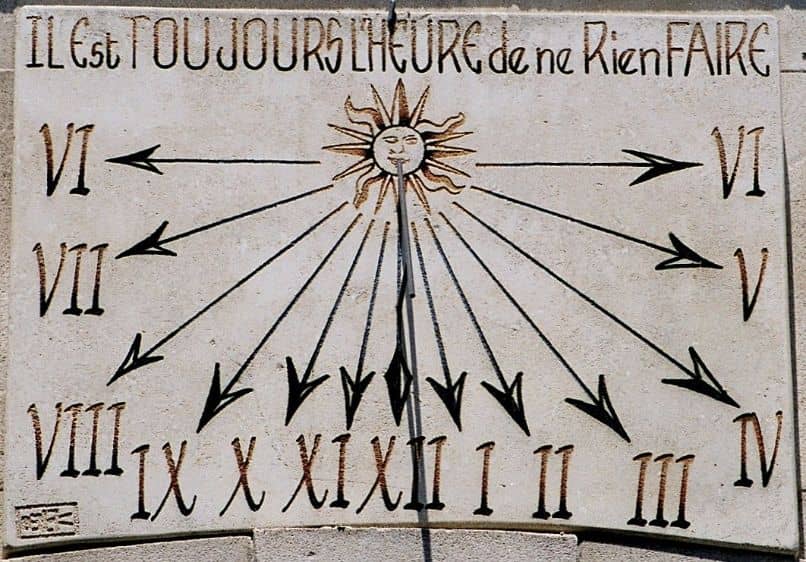
Source: Wikipedia
From a more detailed perspective, the sundial is based on the sun's orbit around the Earth , parallel to its axis. When a sundial is placed on the Earth's axis next to a perpendicular plane, its shadow will follow the sun's movement.
Generally speaking, the sun makes a precise 360-degree turn in 24 hours without fail. Therefore, every hour it moves 15 degrees, as the sun advances in its daily mission with respect to the Earth. In this way, it is possible to measure with certainty, the hours of the day in which the sun is executing its march.
Sundials, for their part, are not unique. Based on various criteria, there are some worth mentioning. As a result, you will gain a better understanding of them and be able to differentiate between them.
The excellent precision of the equatorial clock
It is known as one of the easiest watches to read, with accuracy fully vouched for by those who have worn it. In general, it is a tilted sundial, whose coordinates are based on the equatorial coordinates.
Its design features a style positioned and oriented towards the Earth's parallel axis. In turn, the circular surface on which it rests is perpendicular to this axis, pointing towards the site's horizon.
Like the rest of sundials, it effectively indicates the degrees that correspond to each hour when the sun moves. That is to say, it is one of the clocks that shows, without problems, each hour of the day as the sun moves 15 degrees.
The most common of all, the horizontal clock
Indeed, the horizontal sundial is the most commonly found in squares, gardens, and public spaces as an ornamental item. Its structure is based on a flat, spherical surface perpendicular to the Earth's horizontal plane.
On the other hand, its style lies raised parallel to the axis of the Earth, projecting, without fail, the shadow produced by the sun. In this way, the hours of the day are reflected, as the sun advances in its different diurnal stages.
Vertical clocks and their modernization
Just as horizontal clocks are common in plazas or open spaces, vertical clocks are commonly found in libraries, churches, and other locations. They are known as such because they are mounted or attached vertically to a wall.
In this way, its flat spherical surface is parallel to the horizon of the site, with the style pointing to the axis of the Earth vertically. Despite its particular position, it is one of the watches that has been most modernized and used today due to its practicality.
The homemade sundial. Is it also a type of watch to take into account? Find out the truth!
A homemade sundial isn't among the most prominent types of clocks. It's more of a rudimentary creation of one of these instruments at home.
In that sense, it is due to the fulfillment of a hobby or the completion of a school project. However, it cannot be underestimated at all. A sundial has the same parts as an original, that is, its style, platform and metric graduation.
A homemade sundial is also an excellent tool to consider building and can be a first step in exploring renewable energy sources, similar to solar power . It saves significant expenses on other appliances and, moreover, consumes no energy and doesn't wear out over time. Even if it's not modernized or adapted to current times, it's just as effective as other clocks.
But then… how to make a sundial? Discover the best tips to meet the goal!
First of all, to know how to make a sundial, certain materials are required to be taken into consideration. An excellent prospect must be supported by a good base, so it is advisable to use a small flat wooden platform. Similarly, as a style or gnomon, it is possible to use a key or long stick.
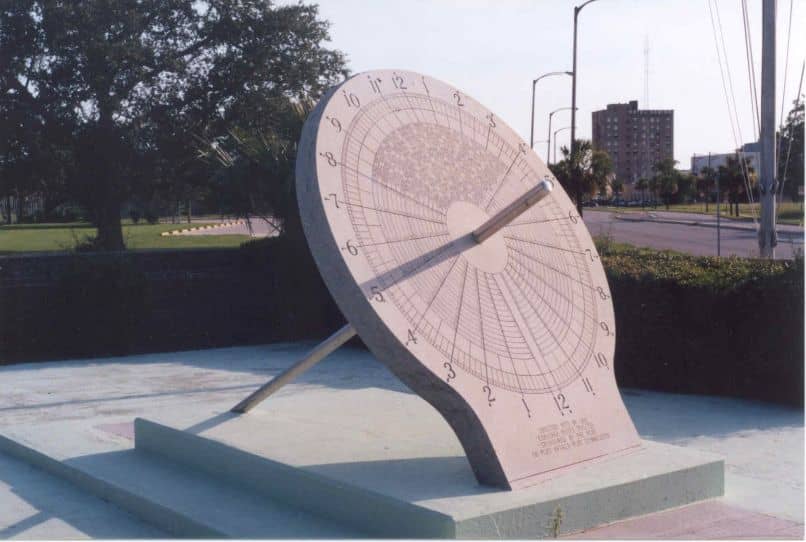
Source: Learning and Teaching Mathematics
Next, it's essential to have a sunny spot for this to work. Place the platform on a level surface and, using a hammer, drive the nail into its center. As the sun's shadow falls on the nail and is reflected onto the platform, mark the hours.
With each hour that passes, use a pencil, pencil, pen, paint, or marker to draw a line under it. For the arrival of the night, the exact hours in which the sun was at a certain point will have been obtained in detail.
Next, simply connect all the lines centrally with respect to the base of the nail . This completes the process of making a successful sundial. Finally, finish by adding color, if desired, or any other decorative touches.
