
Through this interesting article, you can learn all about typical Mexican clothing , for both men and women. Don't miss it! Discover the traditional costumes of various regions of Mexico.
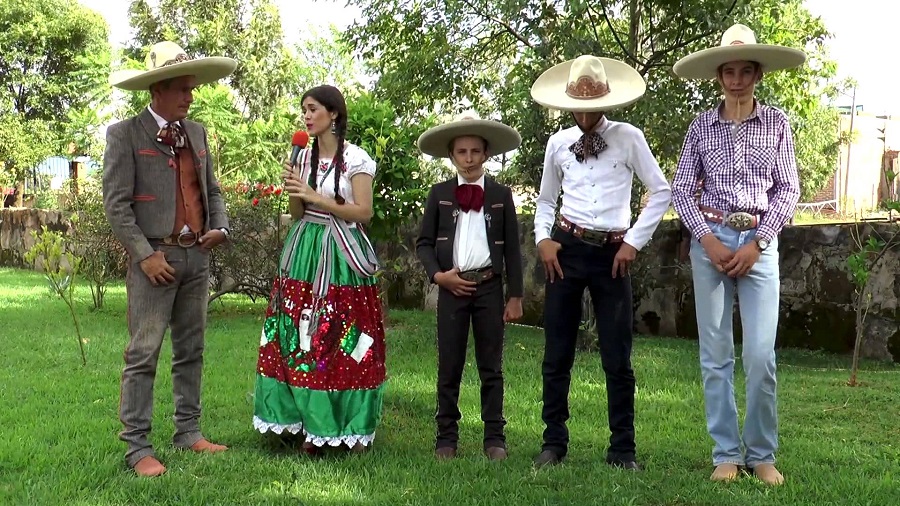
Typical clothing of Mexico by region
The popular costumes of Mexico are the achievement of the union between the indigenous and Spanish civilizations, as well as the vestiges of the Indians, Aztecs, Mayans and other indigenous ethnic groups. The typical dress represents not only the culture of the country, but also the habits of the more than 60 million people in Mexico.
Aguascalientes
Aguascalientes is a state in Mexico in which the National Fair of San Marcos stands out, which takes place every year between the months of April and May.
Competitions are held there that reward the best costume and, therefore, the costumes that are seen in said party are the most elaborate, colorful and striking. They show the costumes of the women, who are the ones who spend the most time and who participate in these contests.
Although you can find the most varied costumes, the most typical costume was designed by Jorge Campos Espino and carried a great diversity of ornaments, which means that none of these dresses lacks a great variety of designs that represent everything from animals to fruits, all of which are still handmade. The women's suit always has a high neck, wide sleeves at the shoulders and very tight at the waist.
Chiapas
The most representative costume of Chiapas is that of Chiapaneca, originally from the municipality of Chiapa de Corzo. It is said that this dress, made up of colorful flowers on a black or dark background, was originally designed as a way to represent the jungle and its fascinating flora, in which colors stand out.

The costume consists of a satin blouse with a semicircular neckline that leaves the shoulders open. The lower part, the skirt, is embroidered with colored flowers, among which orange, pink, blue and white colors predominate.
The manufacture of this suit requires flower embroidery, silk thread is used, so the production process is long and requires a lot of patience.
The quechquémitl is also typical, a kind of blanket or poncho that is placed on the upper part of the body and through which the head is inserted.
It also highlights the fabric and patterns of the traditional wedding dress from the municipality of Zinacantan, also located in Chiapas.
Chichén Itzá
The archaeological site of Chichen Itza is located on the Yucatan Peninsula and is part of the indigenous heritage that has survived to this day.
For this reason, the surrounding inhabitants have indigenous customs resulting from the tribal culture that has been preserved in the region.
Therefore, the clothes are characterized by costumes in which there is no lack of flower embroidery with a wide color palette on a white background. Women's dresses can be found in many colors, but they always stand out with one main feature: they are fitted at the waist.
Guadalajara
In the city of Guadalajara (Jalisco, Mexico), men's and women's costumes are called charro suit, although this name is known throughout the country because these costumes have traveled all over the world.
As for the woman, it consists of a tangle of blankets, the length of which almost reaches her ankles. The skirt is covered with embroideries made with the cross-stitch technique in a linear way and with threads of a wide variety of colors.
The one for men can be the typical mariachi, which is black, adds color details and includes a charro hat, or it can include some type of poncho made of wool, llama, alpaca or other wool fabric. animal.
This poncho has an opening in the center through which the head is inserted and usually has thick stripes or other patterns in different colors.
In its origins, the poncho, which is now used throughout Latin America, was used by Indians, mestizos, whites, gauchos, etc. and is still preserved today.

Hidalgo
In Hidalgo, there are three areas in which a cultural identity prevails that is distinguished by its own traditions and customs, among which clothing stands out. Thus, we find three different regions: the Sierra Tepehua, the Mezquital Valley and the Huasteca.
The Tepehua are an ethnic group whose traditional clothing is characterized by being designed for a temperate climate, so it is a blanket that almost always includes red embroidery, although green thread can also be used.
About the Mezquital Valley, the outfit is quite similar to that of the Sierra Tepehua region, since it is also made of a blanket, but the embroidery it uses is called pepenado and can be found in black and red thread. , blue, green, etc
This style of embroidery represents indigenous values such as the Nahui Ollin or the Chinicuil. Finally, the Huasteca region includes northern Veracruz, southern Tamaulipas, parts of San Luis Potosí and Hidalgo, and the Sierra Gorda of Querétaro.
The latter is dominated by a hot and humid climate at the same time, so the typical costume consists of a short-sleeved white blouse on which flower-shaped embroideries are woven in infinite colors.
Michoacán
The culture of the Mexican state of Michoacán is known as the Tarascan or Purépache culture, which already existed in pre-Columbian times, around 1200 BC.
Therefore, the current Purépechas have specific indigenous traditions among which there is no shortage of typical clothing, the result of the various craft activities carried out by the inhabitants of this community.
Special mention deserves the women's costume, which consists of a skirt and a shirt. As for skirts, there are two types:
- Sabanilla: it is a kind of rectangular canvas made of wool and woven by hand. Its width was originally used as shelter during the cold winter nights, hence the name sabanilla. During the day, this skirt serves as a skirt and is closed at the waist with a belt.
- Zagalejo: it is also made of wool and differs from the sabanilla because it has a brightly colored cotton band on the top, which contrasts with the band on the bottom, which is light in color.
The shirts can be found in different types, although perhaps the most common is one that folds over the chest and back and is embroidered with white or colored details.

Nayarit
The Cora and Huichol Indians have sustained their tradition for thousands of years, and today the typical male costume of Nayarit is that of the Huichol, derived from the creative culture and artisan skills characteristic of this indigenous community.
Huichol women are known to be the best weavers in Mexico, mostly because of their artistic abilities and manual dexterity, resulting in extraordinary wool garments with unique designs. The men's suit is characterized by the use of a white blanket and a shirt, whose cuffs are open and embroidered with symmetrical patterns in different colors.
As for the female dress, it consists of a blouse of a single color that includes exterior and interior waters and to which is added a cape that covers the head and beaded necklaces.
Oaxaca
Although all the typical Mexican costumes are characterized by being very colorful, the clothes worn by the women of this area are perhaps the most colorful of all. In these dresses, a mixture of indigenous traditions and colonial manufacturing techniques converge, such as bobbin lace or Flemish Dutch, among others.
In the Jamiltepec district in particular, the dresses have a wide range of native symbols, such as the sun, stars and other geometric shapes that are often reminiscent of spiders or lizards. The typical or rolled skirt is called pozahuanco.
Puebla
The quintessential typical dress for women in the state of Puebla is known as china poblana, which is made up, at the top, of a low-cut white blouse, which shows part of the neck and bust. Its color is white and it has colorful embroidery, which is usually in the shape of a flower. At the bottom, the woman wears a skirt known as a beaver, due to the fabric from which it is made.

This skirt, which can also be called zagalejo, consists of two layers: first, the upper layer, which measures about 25 cm and is made of calico or green seat (called corte); second, the lower layer, which is covered with sequin patterns and reaches the ankles.
Saltillo
The population of Saltillo is the capital of the state of Coahuila de Zaragoza and whose typical male costume is recognized by the name of sarape or jorongo.
It is a type of poncho that has been used since its origins as a shelter, since it is made of cotton fiber or sheep's wool. The thread, as in almost all typical Mexican clothing, is multicolored and the woven patterns are unique and open to the imagination.
As for women's clothing, it is characterized by embroidered and frayed blouses that can be found in infinite colors and with embroidery of flowers or other geometric shapes.
Yucatan
The typical Yucatan female suit is called a terno due to the three pieces that make it up: fustán, huipil and doublet. The fustán (called pico in Mayan) is the one that is the lower part and consists of a kind of skirt adjusted to the waist and that reaches the feet.

This skirt dates back to the time of the Mayan women. The doublet is the square necklace that is placed on the huipil, which is the white dress itself. In addition, this costume is completed with a kind of shawl called a rebozo de Santa María and a filigree rosary, handmade by the Yuctaec goldsmiths.
Veracruz
The typical costume of Veracruz (Mexico) stands out because white predominates there, whether in the case of male or female clothing, and it is called the jarocho suit.
The women's dress has a long, wide skirt that covers the ankles, and in the neutral white color, lace or embroidery is sewn in different colors. An apron or apron is placed over this skirt, which is usually black, brown or burgundy and the fabric is velvet.
This apron can also have embroidered details in different colors. The top is the same color and may or may not have sleeves.
Finally, it also includes a silk shawl that is usually yellow with white details and may have fringes or other decorative elements.
The male attire, on the other hand, has white pants and a shirt also of this color, which must always have four pockets (called bags in the area) and four pleats or folds in front and another six behind.

typical clothes of Mexico
If ever, the typical Mexican costume is a conjugation of Spanish and indigenous cultures such as the Aztecs, Mayans and other indigenous ancestral groups. The Charro suit is the one that most represents the country.
Originally, it distinguished the social status of employers and their trusted workers from that of other farmers. The suit consists of a hat, pants, shirt or vest, ankle boots, a shawl tie, and a jacket.
Typical men's costume
The typical men's costume is the one worn by Mexican charros.
Traditional charro suits: The charro suit was worn by landowners and their trusted employees. Materials such as suede, wool, or a combination of both are used in its preparation.
They are made for everyday life or for special occasions. The most used colors are brown, dark blue, brown, gray and dry green that contrast with the frets and buttons.
The style of the shirt can be a military collar, popularly known as a "pachuqueña", or a civilian collar known as a "folded collar". The colors used for this garment are white and bone. As for the boots they wear, they should be honey, brown, or berry colored.
Charro hat: This hat is characterized by its wide brim and raised back. Skilled artisans use wool felt, rabbit fur, or wheat straw to make it. It is the most important garment of the traditional charro suit. It is decorated with embroidered cuffs and edges.
Typical costume for women
The typical costume of the Mexican woman is that of the China Poblana. This Mexican dress features several elements that were part of the culture of New Spain. The China Poblana costume is made up of:
- A white shirt with frayed work and silk and beaded embroidery. It had geometric and floral designs in bright colors.
- A skirt called beaver, which was worked with sequins and shrimp that formed geometric and floral patterns.
- Some white beans, with enchilada points, that is, with the lower edge bordered with a lace of zigzag patterns.
- A band that was used to tie the beaver and beans to the waist of the woman who wore it.
- They used a shawl to protect themselves from the cold.
- Satin shoes embroidered with silk threads. In addition, her outfit was completed with pearls and jewels that adorned her ears, bare chest, and hands.
Typical costume by regions
State of Tamaulipas
Tamaulipas Leather Suit : This is a traditional Mexican garment representing the state of Tamaulipas, made from calf or deer hide. It features white and floral designs. These embellishments include long fringes on the sleeves, back, front, and hem. It often displays the state's coat of arms on the back.
New Lion
Women's clothing is the same as that used in the XNUMXth century: blouse and skirt. The white blouse, in a soft and fresh fabric like dacron; the chest, with pleats; the sleeves are wide and smooth; the cashmere, wool, waterproof or polyester skirt, in dark or pastel colours.

Its cup has a base of twelve blades with six hidden folds; It has six frets formed with a chevron or barred tape and finishes the ornament with large knobs lined with the same material as the fret. The costume is accompanied by boots or shoes in white or black.
Baja California
This state was named -in 1952- as number 29 in Mexico. From then on, the governor wanted Baja California to have an anthem, a coat of arms and a costume that would identify the region. Thus, on March 4, 1994, a call was launched to choose the typical costume of the region.
26 combinations competed. Among them, the "Flower Cucapá", directed by María de la Cruz Pulido Vera, won the victory and was modeled by a young woman: Rosa María Rodríguez.
This typical Mexican costume consists of a dress with a round neck, short sleeves and a wide skirt. The entire dress has embroidered details such as cacti and fish.

Baja California Sur
The typical costume of Baja California del Sur, also known as "Flor de Pitahaya", was created in 1951. This Baja California Sur costume is characterized by being very white, except for a part of the skirt. The back is made up of a short-sleeved white blouse. The collar is wide and a V-shaped fabric comes out. For its part, the wide skirt is red and adorned with large white flowers connected by a network of beautiful cacti. At the bottom there is a very white frill.
Campeche
The origin of the Campeche regional costume dates back to the days of New Spain. The elements that make up this costume are of colonial and Mayan origin. Legend has it that the typical costume was born when employers gave costumes to their employees 4 times a year. These times were during the carnival, the festivities of San Juan, San Román and La Purísima Concepción.
The costumes donated by customers were "huipiles" and calico or chintz skirts. Huipile blouses are square. Onion and pumpkin flowers are embroidered on the neck. The skirt has a white underskirt or as it is commonly called: petticoat. The complement of the outfit was a scarf, but now an overflow of "Santa Maria" is used
Coahuila
As for the trousseau of the women of Coahuila, we know that they are dresses with a wide skirt and in very bright and light tones such as yellow, green, purple, blue, etc. Details such as embroidered figures of plants from the region or distinctive elements are added to the dresses. The men's suit consists of a denim shirt and blue jeans. Both men and women wear boots with engravings that represent the identity of their region.
Colima
In the state of Colima, the typical costume is perhaps due to one of the most practiced dances: that of the conquest. This celebration is also known as the festival of; capes, malinches, apaches or "the Virgin of Guadalupe".
It is precisely during the novena of the Virgin of Guadalupe that the typical costume is worn. This consists of a beautiful white dress embroidered with "cross stitch". On the upper front part, the image of the Virgin is embroidered. Flowers are embroidered on the skirt. To make the costume even more elegant, you can add an embroidered veil and cover it with your head.
Guanajuato
The typical costume of Guanajuato is known as "Galereña". The name is due to Galician women, by the name of having worked in the mines or "galleries". These women were breaking stones outside the mines. This is to reduce rocks so they can be processed more easily.
The dress of the galleys was changing and was adopted as the typical costume of the state. This costume was a dress made up of several pieces; a blanket skirt called Zagalejo, over which a red flannel skirt decorated with green triangles around the waist.
If you found this article about traditional Mexican clothing interesting , we invite you to enjoy these others: