
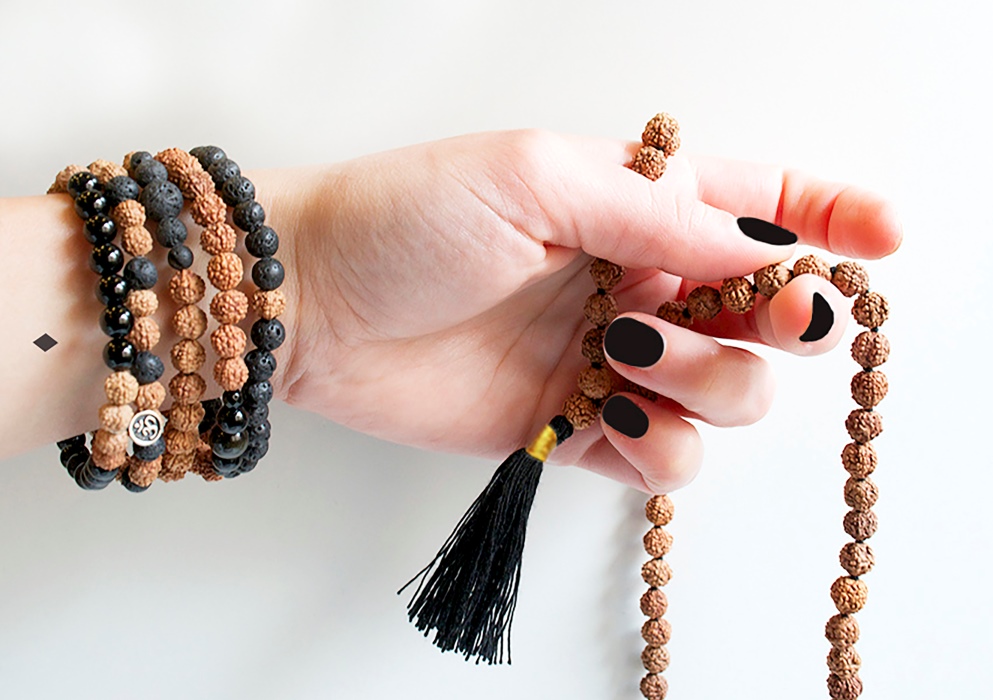
The Hindu rosary , also known as a mala or japa mala , is a string of 108 beads, usually made of wood. It is widely used by practitioners of Hinduism, Buddhism, and Sikhism , who use it to invoke the names of their deities or simply to chant mantras.
What is a Hindu Rosary or Japa Mala?
The Hindu rosary, popularly called a "Japa Mala ," is almost always made of wood and contains 108 beads. This rosary is used primarily by Buddhists and Hindus who, while moving the beads, recite mantras, which are a type of sacred sound. If you want to learn about other symbols, you can look up the Tetragrammaton.
This activity allows them to have better meditation and concentration. The term “ Japa ” means “repeating prayers,” and “ Mala ” refers to a necklace, so the combined word means “a special necklace for repeating prayers.”
The use of this Hindu rosary is related to the use of a powerful meditation technique, where two of the five senses of the person are used: touch and hearing; the first while he touches the spheres with his fingers, and the second, while interpreting the mantras.
Etymology
The Hindu rosary, known as a Japa Mala, is pronounced " japa mala ." Etymologically, the term derives from the verb " yap ," meaning to murmur or speak softly. This refers specifically to the act of reciting prayers, incantations, and other devotions, and can therefore also be interpreted as praying in a low voice.
This term first appears in the mid-1st millennium BC, in the records of the books Aitareia-brahmana and Shatapatha-brahman a. There are some elements belonging to other devotions that have some relation to the Hindu rosary, for example, the shape of the arrangement on the cord, very similar to the rosary of the Catholics and also a similarity with the tasbih , which is the Muslim rosary.
The 108 rosary beads
The answer is related to the fact that 108 is a number made up of three digits, which in turn is the result of an equation where the multiple of 3 was taken. When the number 3 is added three times, it results in 9 .
Within Hindu numerology, the number 3 has a great meaning, as it represents the balance between the spirit, the mind and the body, in a total and perfect way. Within the culture, the Hindu rosary must be held in the right hand, passing the beads or spheres between the thumb and middle fingers.
The specific selection of these fingers is because the thumb symbolizes the general mindset, while the middle represents purity. There is another model of the Hindu rosary that has 109 beads or spheres.
Number 109 differs in size from the others, as it is much larger, and from it hangs a kind of thread in the shape of a feather duster, which represents the house of the gods, the so-called sacred Mount Meru.
The materials used to make the Japa Mala or Hindu rosary can be lotus plant seeds, sandalwood or rosewood, animal bones, semi-precious stones, the most commonly used being amethyst or carnelian.

How to use the Hindu Rosary?
In order to use the Hindu rosary effectively, the first thing the person should do is adopt a meditative posture, choosing a calm place for it. Then you should also select a mantra of his preference.
Next, take the Japa Mala in your right hand and begin passing the beads between your thumb and middle finger. The correct way to start is from the top of the cord down, passing each bead while repeating the mantra.
It's important to note that if the round ends, you shouldn't move on to the largest bead. To continue, turn the rosary over and begin again in the opposite direction. The mantra can be chanted aloud or softly, depending on your technique or preference. You can also explore other topics such as the Five-Pointed Star.
Benefits of its use
Among the benefits obtained by using the Hindu rosary are: through meditation and the recitation of the mantra, the level of concentration increases; It is presented as a good dynamic for the interpretation of mantras or prayers.
It serves as a method for counting the number of mantras recited during a meditation or prayer session; according to tradition, physical contact with the spheres emanates the healing powers contained in the prayer; as the Japa Mala strengthens , it serves for the healing of the individual.
Hindu Japa Mala
The Hindu rosary used by the followers of Hinduism is made from tulasí wood (basil tree) or sandalwood, but also from seeds. Between the spheres, a knot is placed and between the eighth and ninth spheres, a thread is tied separating them.
Some of these rosaries bear the name of the god Vishnu on each bead . They contain an extra bead, the 109th, which is larger than the others and is located in the middle with threads hanging down like a feather duster.
When using it, it is done just like the traditional Hindu rosary, taking it with the right hand, and passing the spheres with the thumb and middle fingers, while pronouncing the mantra. The rosary is advanced forward and when the mantra has been recited 108 times, its repetition corresponding to the number of beads, which is known as the round of japa.
To fulfill a new round, the rosary must be turned completely, starting with the sphere with which the previous round ended, that is, number 108. There is no restriction as to whether it should be sung aloud or low, because the important thing is to do it with concentration on the sound vibration in a very attentive way.

It is generally practiced in the mornings with complete concentration, specifically during the so-called Brahma Muhurta hours , which are counted 96 minutes before sunrise and last approximately 48 minutes. The number 108 is of great importance to Hinduism, as it is considered a perfect three-digit number, being a multiple of three whose result is 9, or the sum of three times three.
Records indicate that the largest bead represents the god Krishna , while in other accounts it symbolizes Mount Meru, which, according to the culture, is the abode of the gods. It is also said that the fact that the Hindu rosary has 108 beads or spheres is linked to the fact that the god Vishnu has 108 principal names.
Buddhist Japa Mala
The members of the Tibetan schools belonging to the Buddhist tradition are the ones who mainly use this Hindu rosary when reciting their mantras. The piece is made up of 108 beads or spheres, made of various types of materials and organized in the form of a necklace.
It can be worn as a decorative piece around the neck or on the left arm. As for its structure, it has a division of three parts, fixed in accounts number 27, 54 and 81, which divide the rosary into four equal parts. It contains one of the beads larger than the rest, which is where the prayer begins and ends.
There are two models of this rosary: one that ends in a series of strands, and another that instead contains two beads, one round and one cylindrical, representing the wisdom of the Buddhas . The number 108 also has several meanings within the religion, as it is said to represent the number of mental obscurations that exist and prevent a person from seeing through the eyes of the Buddha.

In the same way, it is considered that it is the result of the formula that results from the three types of experience: negative, positive and neutral, which in turn are multiplied by the 6 senses: smell, taste, vision, touch. , smell and mind or consciousness, whose total is 18. This 18 is multiplied by attachment and aversion, and results in 36, which in turn is multiplied by the three forms of time: past, present and future, and this is how you get the 108.
According to this tradition, once the 108 count is surpassed, the state of enlightenment known in Buddhism as nirvana is attained . It also represents the Three Jewels: the Buddha, the Dharma, and the Sangha. The beads are turned using the thumb and forefinger, the former representing the Buddha and the latter the individual.
Upon reaching the final count, the japa mala should be rotated without passing the largest bead, restarting the count. It is made from wood from the Bodhi tree, famous as the site where Buddha attained enlightenment. It can also be made of sandalwood or animal bones.
in sikhism
In Sikhism, a Japa Mala is also used for prayer and meditation, with practitioners constantly repeating the name of God, which in that culture is Naam . They may also use it while chanting a mantra, the most common being the bija mantra " Sat Nam ," meaning "eternal name."
Guru Nanak, the founder of this religion, is often depicted carrying a Japa mala in his hands or around his neck. If you enjoyed this article, you can also check out our blog post , Tarot Truth or Lie.
