
The sun's influence on Earth and the other planets is immense; so much so that everything literally revolves around it. Countless myths and legends are associated with its name , as well as with the effects it exerts on every corner of the planet. A prime example is the infamous solar storm, an event that constantly threatens humanity and its daily lives.
And yes, it is normal to feel uncertainty or some panic when talking about solar storms, but most are just myths without foundation. Therefore, it is necessary to properly delve into the subject to avoid falling into the jaws of misinformation, something very common these days.
You might also be interested in our article: Northern Lights on a comet? Discover what the Rosetta Mission has found!
Defeat misinformation, find out what solar storms really are
Source: The Time
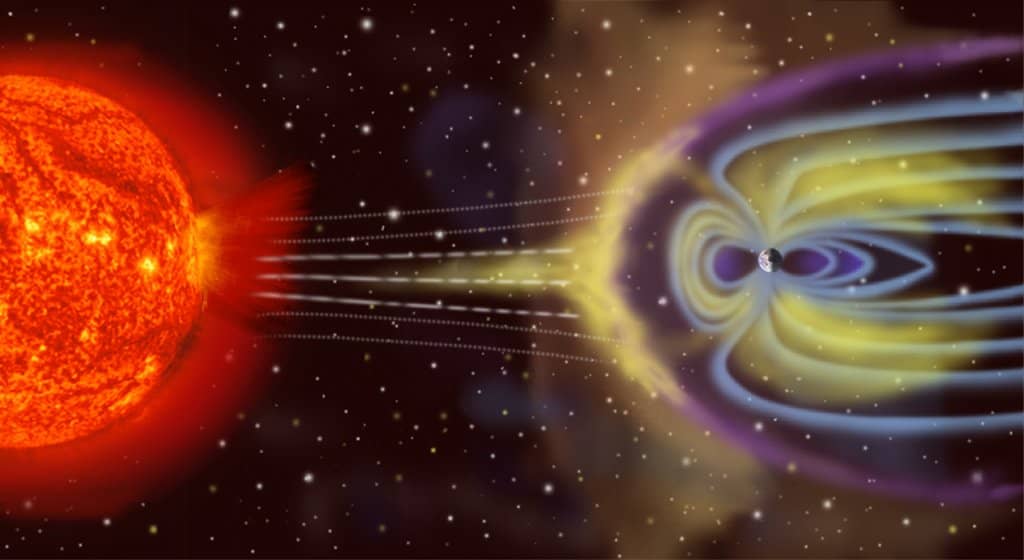
In the realm of space, there is a term known as solar weather , which describes the sun's constant activity and its effect on the planets. Solar weather sometimes intensifies or remains at bay, producing varying degrees of impact on the cosmos. To define exactly what solar storms are, it's essential to first understand that the Earth possesses a magnetic field.
This magnetic field, or "magnetosphere" in its scientific name, is in constant interaction with the weather and solar winds , producing the famous aurora borealis. In effect, they are a basic or initial result of the solar wind impacting Earth, without generating any further complexities.
Now, what are solar storms? Well, they are events that, for some reason, present an intensification of solar activity in its entirety. They affect the magnetosphere and according to their magnitude, they can motivate the cause of different effects beyond an aurora borealis.
The mechanics of solar storms are the same from one to another, varying only in the intensity with which they occur. Basically, a solar eruption occurs, and its shock wave, in a matter of minutes—about 7 or 8—impacts the Earth's magnetic field.
This shock wave is composed of radio waves, gamma rays, ultraviolet radiation, and the typical solar wind already discussed earlier in this article. Another important aspect is the coronal mass ejection within the shock wave onto the magnetosphere. Combined with the other characteristics mentioned, the main areas affected are usually radio communications and radar operations.
Find out a little more about the effects of solar storms on Earth!
Determining what is true and what is false regarding this topic is a difficult task. However, a series of scientifically proven effects of these space phenomena on Earth have been compiled below.
Is it true that they are harmful to health?
Much is said about the premise that solar storms cause damage to people's health. It has even been mentioned that they are deadly, with alleged unquantified or unsupported evidence on people who have died from it.
Don't fall for speculation! There is no proven evidence that large-scale solar activity harms an individual's health. Major organizations like NASA and ESA have refuted this information, based on solid arguments.
Can communications and the electrical system fail?
In general terms, yes, it's possible, but it depends primarily on the strength of solar activity. Typically, the solar wind is in constant interaction with Earth's magnetic field. The latter protects human activity from its effects.
Still, you should know that not everything is perfect. When the intensity of the solar wind intensifies or solar storms occur, various electrically charged particles filter through the magnetosphere.
In conclusion, these particles damage the wiring in various areas and the transformers responsible for providing electrical service. In turn, they are directly responsible for interference with telephone calls and GPS use.

Find out what happens to radios and radars
Just as the GPS of specialized devices for this purpose fail, so do radios and radars. As already mentioned, solar particles intervene in the normal processes of the operation of these devices.
This is because the radiation and energetic particles cause total interference for the duration of the solar storm . They can even render these devices completely unusable for an extended period.
That is why great care must be taken with ships or aircraft and their navigation system during a solar storm. If they fail, they could face an inhospitable environment; however, today technology is ready with a plan B.
Satellites are also no strangers to impact

Source: People's Daily
Although it's commonly believed that the primary damage occurs on the Earth's surface, satellites orbiting the planet are also victims. Intense solar activity can cause erratic behavior in their orbits around Earth. Ionization of the planet's outer layers destabilizes the satellite's normal trajectory, making it erratic and requiring timely correction.
Furthermore, interference from the solar wind and energetic particles in its composition contributes to satellite malfunction . What does this mean? The satellite begins transmitting erroneous or abnormal signals, causing an imbalance in signal reception.
Solar storms and earthquakes… are they related?
This point is just as controversial, if not more so, than those mentioned previously . The powerful earthquakes in Mexico and Japan in 2011 coincided with periods of heightened solar activity. This curious fact led the United States Geological Survey to issue a statement regarding the relationship between solar storms and earthquakes.
However, the scientific community has not yet reached a conclusive answer to this question. There is only evidence that several terrestrial events or cataclysms coincide with periods of solar dormancy. Nevertheless, linking solar storms and earthquakes is still too early to provide a unifying theory.
