
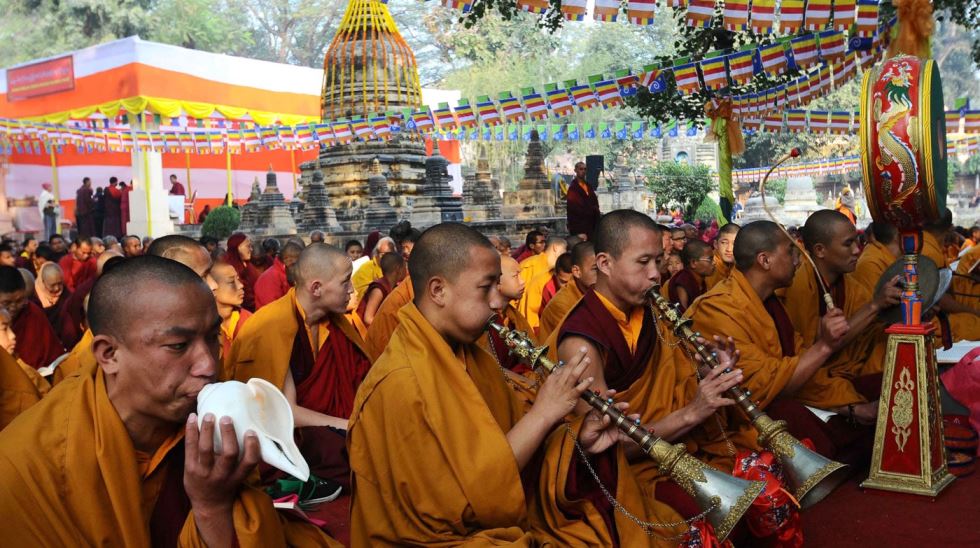
Buddhist rituals are activities performed to celebrate or commemorate specific events or dates, most of which are religious. These rituals include initiation rites, death rites, New Year celebrations, and others, which you can learn about here.
Meaning of the Rite or Ritual
To discuss Buddhist rites , we must first define what a rite or ritual is. Rites are explicit manifestations of a people's customs or traditions through the performance of ceremonies. These ceremonies, when repeated, cannot vary; rather, they must follow a pattern according to rules or parameters previously established for each particular rite.
Generally, rituals are performed symbolically and are used to express the essence of a story, tradition, myth, or ancestral legend. In the case of Buddhist rituals , the acts or ceremonies that comprise them derive from the spiritual, religious, and philosophical doctrine emanating from the teachings of the Buddha , the supreme teacher and priest.
Each of the world's known mythologies has its own practices, rites, and sacred festivals, based on its beliefs, dogmas, and doctrines. The methodology of Buddhist rites encompasses diverse religious and philosophical aspects, including initiation rites, death ceremonies, rites for welcoming and celebrating the new year, and many other rituals and ceremonies.
It can be said that Buddhism is one of the mythologies or traditions with the most rituals; in other words, it is replete with them. Among their characteristics, Buddhist rites are framed within mystery, especially those performed to embark on the path to spirituality, making the experience something truly wondrous for its participants.

What are the Rites of Buddhism?
The rites of Buddhism are the different expressions of a religious or philosophical nature, expressed through the performance of cults or ceremonies that allow its participants to honor, commemorate, or simply celebrate the various teachings that the Buddha master left throughout the world, while at the same time honoring his memory.
It's worth noting that Buddhism is considered more than just a religion, due to its wide range of traditions, culture, beliefs, ceremonies, rituals, festivals, and other practices. You can learn more about this topic in the article " Gods of Buddhism."
And although every religion, mythology, or philosophy known and popularized in the world also has its own sacred rituals and festivals, those of Buddhism surpass any other multicultural tradition in number. Buddhist rites are incredibly rich, considered not only mysterious and cult-like ceremonies but also exotic.
The elements that are used in each of them, the colorful costumes, the scenery that they perform, the content of their dances and other festivals, as well as the purposes that are pursued with the performance of each ritual, is what has made this, an ancient culture, considered by many as a wonderful philosophy.

Buddhism is a doctrine originating in India, which was adopted as a philosophical doctrine dating back to the 6th and 4th centuries BCE. It then spread throughout eastern Asia, gradually becoming the fourth most practiced and important religion in the world.
This translates to approximately 7% of the world's population practicing Buddhism, an estimated 500 million followers. More than a religion, Buddhism is considered an ideology whose stated purpose is to identify the limitations and weaknesses of human beings and enable them to overcome these limitations by strengthening both body and spirit.
One of the universal methods that Buddhism uses to achieve this goal is the practice of meditation, which is the path and strategy indicated by this doctrine to find and obtain supreme wisdom, which is the highest principle of this philosophy.
However, to achieve this goal, Buddhism has established certain rules and knowledge derived from the teachings of the Buddha , the master and leader of the doctrine . Likewise, the rituals of Buddhism are derived from this knowledge and these teachings, and they are necessary for each person to purify their being and their soul.

That is why this methodology should be taken as a kind of spiritual exercise and practiced constantly, because it is what will allow us to recognize, accept and transform the mistakes that have been made in life and then correct them.
Specifically, the practices and performances of Buddhist rites , ceremonies, and other celebrations serve as the basis for the full recognition of each person's potential, so that they can achieve the much-desired wisdom.
Nirvana is one of the main tenets that encapsulates the foundations of Buddhism. Through the performance of various Buddhist rites, one can achieve: first, liberation from all desires; second , attain individual consciousness; and finally, embark on the path to reincarnation.

Main Branches of Buddhism
It has already been said previously that the rites of Buddhism are derived from the teachings of this religious and philosophical doctrine, but in addition, the celebrations, traditions, cults and other festivals are framed within its main branches, among which are:
Theravada
Also known as the School of the Elders, this branch of Buddhism developed in Sri Lanka and is characterized by its conservative approach to doctrine ( dhamma ) and monastic discipline. The fundamental basis of Theravada doctrine rests within the contents of the Nikayas of the Pali Canon.
Mahāyāna
Also known as "the Great Way". This branch of Buddhism includes the acceptance of other texts, dogmas and doctrines, which is why it is not considered a rigid and centralized branch.
Vajrayāna
It is understood as a variation or extension of the Mahayana branch of Buddhism . This branch incorporates the use and practices of additional techniques such as upaya, generally considered more esoteric than religious. Also within this foundation of Buddhism , the use of mantras, mandalas, dharanis , mudras, and other elements of this doctrine is employed .

It is necessary to know the branches of Buddhism and all its philosophical foundation, since the rites of Buddhism are based on the different traditions of this ideology, even pursuing the same goal as the doctrine itself, which is to honor the memory of Buddha , as well as his actions on Earth.
According to each branch of Buddhism , the rites will then be different, given that each of them has a different perspective, as well as possessing a particular belief in how these ceremonies and celebrations should be carried out.
Religious Rites of Buddhism
As previously stated, the practices associated with Buddhism are not presented as part of a religion. Therefore, it is best defined as a philosophy of life whose purpose is to understand a person's weaknesses and limitations, and once identified, to renew and strengthen their spirit through the practice of meditation, as taught by the Buddha.
The reward after this entire process is attaining supreme wisdom, which is the aspiration of all who practice it. This ideology of Buddhism maintains its foundations or principles within certain rules, which are expressed through various rituals that help each human being purify their soul.

These guidelines, established by this dogma, indicate the path to Buddhism, considering enlightenment as a spiritual exercise. With perseverance, this enlightenment allows each person to understand their own mistakes. The ability to recognize and accept these mistakes is also part of this philosophy's teachings, enabling transformation as the next step in the strategy.
Said step is not only precise, but also necessary within the scheme, that the rites of Buddhism as part of that same doctrine, have established as their final objective, the total understanding of all the potential that the person has, raising their preparation for the reach of total wisdom.
Full wisdom is the ultimate goal of Buddhism, which also preaches the search for tools and techniques through which one can achieve liberation from desires, reach total consciousness individually and subsequently reincarnation, which together refers to what is called Nirvana.
There are thus, rites of Buddhism that contribute to progress with respect to the achievement of these objectives, the best known in the religious part being the following:

Genuflections (bows)
Genuflections , also called bows, which are done on the ground, are part of the Buddhist rites categorized as pious, where the faithful devotees and monks participate, as a way of paying homage to Buddha through worship.
These genuflections or reverences can be done in two different ways: one of them is done by developing the march of any faithful devotee and then he stops to recite the universal mantra: On Mani Padme Hum.
As you say these words, you should have your hands together in front of your chest and then raise them up, over your head, taking a step forward, and then lower your hands to your face. He then takes another step forward, bringing the position of his hands to his chest, as he takes a third step forward.
This type of religious Buddhist ritual continues , separating the hands and then lying the torso on the ground, finally kneeling, and extending the entire body. The forehead must touch the floor. At the end, one stands up, but must repeat all the steps again.
The other way to perform the act of reverence is usually within a temple, monastery, or any other place considered sacred. The devout worshipper or monk will touch the ground with their entire body. In this second form of genuflection , the devout worshipper or monk will use a kind of mat which they will spread out in front of them and then begin to perform the same movements as the march.
The purpose of these Buddhist rituals is to use reverence to pray for a special request or favor, to fulfill a promise, to ask for the cessation of a worry, to overcome a difficulty, to avoid suffering, among other things.
Those who practice Buddhism consider the ritual of bowing to be a practice that strengthens the spirit. It is said that the number of bows should be at least 10, performed with the body prostrate on the ground as a sign of respect, with bare feet.

wind horse
The next Buddhist ritual is called " lung ta " in its original language, but translated, it means "wind horse." It is conceptualized as special prayer flags or banners for followers of Buddhist beliefs, representing humanity's destiny in relation to its behavior and coexistence with the five elements of nature (metal, fire, water, earth, and wood).
Buddhist doctrine established a philosophical link between the horse and the wind, which is precisely the basis from which its name is derived. This premise stems from the idea that both (the wind and the horse) are "natural vehicles," considering that the animal is used as a means of transporting material and tangible elements, while the wind, for its part, carries the intangible, such as prayers and supplications.
The banderillas have a rectangular geometric shape, made of cloth material or also paper, classified by groups containing five colors, through which the five universal elements are symbolized: metal, wood, water, fire and earth. In addition, the figure of the animal that symbolizes each of the five elements is also printed on these banderillas.

The way in which these banderillas are ordered is from left to right, in a certain and specific way, below we will show the exact order:
- Blue flag, which symbolizes and is associated with the sky and space.
- White flag, which represents the wind and air.
- Red flag, associated with the fire element.
- Green flag, which represents the element of water.
- Yellow flag, selected to symbolize with it the Earth element.
These flags or banners are typically hung diagonally in a line, from a high point to a low point, connected between two objects. These high places where the flags are usually displayed are temples, monasteries, high mountains, or stupas , which are Buddhist structures adorned with various relics, among other things.

Purification with Yamantaka
Purification with Yamantaka is another ritual in religious Buddhism considered very special, as its name suggests, it consists of the purification or cleansing of energies. It is a ritual or ceremony performed by monks, through which they cleanse people's energies using the four elements: water, air, earth, and fire.
It is said that this type of Buddhist ritual is one of the most beneficial practices that exist, since in addition to being religious, it has a medicinal character, helping many people to get out of sick states and depression.
It's worth mentioning that Yamantaka refers to the Buddha who conquered death, and therefore possesses the power to eliminate anything that harms us. The procedure for performing the ceremony is as follows:
The Lama invokes the presence of Yamantaka , and then the ritual begins, employing peacock feathers and kusha grass . With these elements, he cleanses the person's mouth during the ceremony, thereby simultaneously cleansing, sealing, and protecting their energy field.

Christening
Another religious ceremony that appears as a Buddhist rite is baptism. Within Buddhist doctrine, baptism aims to purify the mind. This rite or ceremony is performed to enter the practices of secret esotericism, so each time a new stage begins, it is required to be baptized again.
This implies that if a monk practices the esoteric secret, he must be baptized several times. This baptism ritual is different from the ways in which it is carried out in other religious doctrines such as Catholicism or evangelism and even within the Buddhist doctrine it can become different and vary depending on the teacher who is directing it.
However, the ritual contains a common element: the use of a mandala and holding a bottle. According to the instructions, the person being baptized must imagine the presence of four dragons filling four bottles with water using their mouths.
This water from the four bottles will then be poured over the apprentice's head. Through Buddhist baptism, it is believed that the person being baptized, once the ceremony is complete, will attain total purification of mind and the power inherent in Buddhism.

Confinement
Seclusion is also part of the main religious rites of Buddhism . It is an activity through which the participant or participants break all contact with the outside world, hence its name.
While performing this act, different types of mantras are recited, according to the specific ritual or tradition. The seclusion varies in duration; it can last for a few days, while others practice it for several years. However, regardless of the duration, the participant cannot leave for any reason before the agreed-upon time has elapsed.
The purpose of performing these Buddhist rituals is for the student or participant to have an experience that allows them to cultivate themselves and attain the fruit of Buddhist understanding—its ultimate wisdom. The practitioner of this ritual may perform it several times throughout their life.

Heart Sutra Puja
The Heart Sutra Puja is a Buddhist ritual in which offerings are made to the Buddhas in exchange for receiving many blessings. It is particularly long and intense, lasting an hour and a half.
It is performed to the accompaniment of the loud sound of drums, the offering of prayers and supplications, and the incorporation of sacred music. Its name in the native language is written as “ Sherñing Dondub ”.
During this ritual, the mantra from the Heart Sutra is recited: Gate Gate Paragate, Parasamgate, Soham , which translates to " beyond, ever beyond ." This recitation is considered a very powerful mantra, used to invoke the power of emptiness or void, through which, according to tradition, many Buddhist masters have achieved profound experiences.
This knowledge of the Buddha, or Heart Sutra, is known as the teachings of the essence of wisdom (the highest principle of the Buddhist tradition). This Buddhist ceremony or ritual aims to eliminate the deepest demons that are usually always lurking in our minds.
Based on this, Buddhism contemplates the existence of four types of demons, also called maras , which refer to the story of Buddha confronting and defeating them with that famous meditation under the Bodhi tree.
Said demons were: that of deceit, to which negative attitudes and emotions are attributed; that of death, who is the cause of serious illnesses that end in death. The third of the demons is that of the aggregates.
And the last of the four demons, that of the children of heavenly beings, referring to activities that, although they give us pleasure, at the same time do us a lot of harm, not only to ourselves but also to other people.

According to what the doctrine says, in order to expel all those demons, several offerings must be made during the start of the rituals. The steps to follow are to place figures of animals in four directions, which will simulate false offerings to the demons so that they go away.
In the same way, the figure of a person must be placed, through which those people with ailments due to diseases are represented, which will serve as a support to expel the deceived demons.
In the end, all the demons must be expelled by the effort of the person himself, although the realization of this ceremony helps a lot in the midst of the titanic struggle that is undertaken and that is necessary on the path towards the spiritual.

Khaw Pansa and Ok Pansa
The Khaw Pansa and Ok Pansa are among the most popular Buddhist rites in Thailand. It is a ceremony specific to practitioners of Theravada Buddhism, which includes, among other things, a spiritual retreat.
It lasts for three months and is carried out by the monks, particularly during the rainy season, which runs from July to October, called Wassa in the Pali language or Pansa in Sanskrit within Buddhist philosophy.
The methodology is that the monks stay inside the temples or monasteries with the intention of cultivating themselves, concentrating only on their spiritual growth, using the technique of meditation, in addition to constant study.
Among the rites of Buddhism, this is considered the oldest, dating back to the time of the Buddha himself . This type of rite is typically performed by mendicant hermits in India—those who, by their own conviction, have chosen to live in abstinence and without pleasures, surviving on alms.

Similarly, these were people who generally did not plan trips during the rainy season, as the rains were quite heavy and intense. The name of this rite is Khaw Pansa, which means the beginning of the retreat; and Ok Pansa , which means the end of the retreat.
Other religious rituals
There are many other Buddhist rites considered religious in nature, such as the religious dance, a ritual performed to commemorate the end or culmination of a year. It usually takes place within temples or monasteries, where monks participate in various religious dances, wearing colorful costumes and masks.
Some participants dress as the Yak deity, adorned with various Vajras (diamonds), and some Dharma defenders ( referring to religious laws) also participate . The dance route involves a kind of parade around the monastery, with participants wearing their costumes.

This ceremony aims to banish evil spirits from the year that is ending, while simultaneously welcoming the new year, receiving it cleansed of all negative energy. The Lasuosuo, more than a ritual, is part of an ancient custom inherited from the Tibetan people.
They consisted of sacrificial rituals to honor the divinities of war and mountains. With this term, they referred to the valleys and mountains considered divine, and it has the meaning "God has triumphed".
Animal liberation is another Buddhist ritual considered religious, so named because it typically involves releasing yaks (bovine mammals) and sheep. In Tibetan areas near Buddhist temples, it is very common to see these animals roaming freely, adorned with colorful threads and silk decorations.
These ribbons are usually tied around the neck and are almost always red. The release is a symbolic sacrifice to honor the mountain deity and the Buddhas . It's important to note that the sacrifice is symbolic; the animal is not killed but released into the mountains. It is not harmed in any way, as it will most likely die of natural causes.

Mo is a Buddhist ritual involving spiritual consultations using dice. The steps for this ritual are as follows: The leader, or the master, invokes the presence of the guardian deity, and then the Tibetan dice are cast.
The result will be interpreted to answer the questions asked by the participants of the rite. In addition to the dice, another important element is used in this rite, a special Tibetan diagram, very similar to a mandala containing eight signs, which serves as a "floor", where the dice should fall. According to the place of the diagram and the symbols it contains, the numbers on the dice will be transformed into syllables.
Prayer wheels, which are very common in Buddhist temples and monasteries , sometimes numbering in the thousands, are used in this ritual. The ritual involves wrapping yak and sheep hides in cloth. The wheels themselves can be made of copper or wood.
Their surfaces feature a prayer mantra, while the interior is filled with sutras (sacred texts or discourses of the Buddha ). Based on Buddhist tradition, the ritual is completed by spinning the prayer wheel and reading each of the sutras placed inside. This is said to be how devout followers of the doctrine accumulate merit.
Pilgrimage, this type of Buddhist ritual, involves journeys to mountains considered sacred. Another essential condition is the presence of a stream or lake in this natural setting, as the ceremony includes traversing it to absorb the energies that nature provides.
In addition, it is believed that with the implementation of this rite, other spiritual benefits such as wisdom and protection will be obtained. Similarly, the devotee accumulates merit by visiting holy lakes and divine mountains.
Mani stones are generally the name given to piles of stones placed without a specific order or fixed structure; on the contrary, the pieces are scattered along the edges of roads, rivers, or also at the entrances of some towns and other communities.

However, they are more commonly seen in places considered sacred by Buddhism , as well as at the entrances to streets where Buddhist practice is common . There, one can see a number of stelae or stones carved with sutras , that is, sacred discourses.
Participants in this ritual must place a stone as they pass by the pile, reciting the sutras inscribed on it. It is also common to see walls built with these carved stones, but these are generally found near Buddhist temples or monasteries, or along mountain passes. The largest and most well-known wall is the " Jiana ," which measures four meters in height.
Fire offerings are a type of ritual that involves making sacrifices to deities using fire. It is considered one of the oldest and most important religious practices. The ritual consists of symbolically setting fire to the offerings, as well as to sacred objects.

In their native language, this rite is also known as Joma , Jomam , or Javan , referring to Buddhist rituals involving the burning of gifts or offerings, which are thrown into a previously consecrated fire. In short, the ceremony itself consists of burning the sacrifices in fire, and while this is happening, the appropriate sutras are recited .
Turning to the right is the name of one of the religious ceremonies frequently performed in Buddhist temples and monasteries. Participants in this rite recite the sutras contained within prayer wheels as they spin them.
They must go around the statues, clockwise, that is, to the right, which is why the name is derived from there. The purpose of complying with this ritual is to accumulate merits and thereby request the elimination of diseases or the occurrence of some catastrophe.

Cults of Initiation and Death
As has been said before, the rites are the performance of a series of activities or actions, which have a base based on ideas or dogmas, traditions and beliefs, whether they are of a religious nature or by the culture of the peoples.
Buddhism is one of the philosophical traditions with the most rituals, and it is through the performance and expression of these rituals that it seeks to help its faithful and devoted followers, motivating them to experience new ideals and beliefs through these practices. You can learn more about this topic in the article " What is Meditation ?"
The initiation ritual
The schools of Buddhism encompass various types of initiation rituals. However, the most frequently performed is the Chöd Rite , a ceremony with a strong esoteric component, characteristic of Tibetan Buddhism, established as a secret rite where the apprentice and master strengthen their bond.
This rite involves the completion of 2 phases. The first phase is when the child is already 8 years old and knows the meaning of what it is to be a Pabbajja (a person who decides to leave material things to live as a Buddhist).

Once the child turns 8 years old, he is taken to the Buddhist monastery , according to a set date dictated by his horoscope, with the aim of making the ritual as favorable as possible for the child's destiny and future.
Upon entering the monastery, the boy is greeted by the monks, who make him a symbolic gift of what are considered the three jewels of Buddhism:
- Recognition of Buddha as the greatest teacher.
- The duty to follow his teachings.
- Social integration into the Buddhist community.
After this, he is stripped of his clothes to proceed to put on a special yellow tunic. He also has his head completely shaved and then he is given what is considered by the doctrine as the only objects that every Buddhist monk should have: three pieces of clothing; a razor to shave; a bowl where to put the alms; a belt; a needle; a filter; and a fan.

The next thing to do is read them the 5 basic rules that underlie Buddhist morality, which every applicant must faithfully comply with, these being:
- Do not destroy life.
- Do not steal.
- Do not have a bad behavior.
- Do not speak falsehoods.
- Do not eat products that can alter the state of mind.
This covers the first phase. The second phase is called " Upasampada " and begins after the Pabbajja is completed . During this phase, the young man is considered a Buddhist monk. Each initiate is assigned a senior monk who teaches him the ten precepts that every monk must respect.
In addition to that, they are given the necessary knowledge to learn the gifts of compassion and wisdom. Finally, she must understand the premise of not believing in anything of which she is not convinced. Before turning 20 years of age, the ritual must then be celebrated where the young man will definitively become a definitive monk.

Death Ritual
Another of the cults and rites of Buddhism is the death ritual , a ceremony that the followers of this current commemorate, and which has the purpose of accompanying and guiding not only the soul but also the consciousness of the deceased.
Adhering to the teachings of Buddhist doctrine , this ensures a natural and inevitable passage through death, which is seen by this philosophy as a source of liberation, as well as a great opportunity for consciousness to open up to its infinite potentialities.
However, this ceremony contemplates that the body must be separated from all the weight accumulated in the mind, so that it can walk towards a state of self-enlightenment.
Buddhist tradition states that when a person dies, according to this culture, the minds of those who knew them are closest and most present. This is why, among all the memories united, a great amount of positive energy is generated, which is believed to benefit both the deceased and all those who had a close relationship with them.
To participate in this ritual, it is only necessary to make an appearance, assuming a positive attitude, with a serene and quite calm posture. A prayer is raised for the rest of the deceased, which is also part of the death rite, having a list with the name of the person or persons, in the event that the request is made in a group.

It's important to note that Buddhism , as a doctrine, does not perceive death as something painful or bad; on the contrary, it is seen as another step the soul must take on the path to Nirvana. In other words, the awareness of one's impending death is one of the ideals of Buddhism , as it views death as a necessary transition to reach Nirvana.
Buddhist death rites are also known as Buddhist funeral rites, and there are several types, the most traditional being the so-called " rite of passage ." This ritual can begin even when the person is already dying, that is, when they are still alive but convalescing or seriously ill. A reading is given from passages in the Book of the Dead, titled Bar-do'i-thos-grol.
This reading is done with the aim of providing the deceased with tools to help them cope with what tradition considers an intermediate state between two lives, called " Bardo ." One of the unique aspects of this rite is that the burial lasts for 49 days.
In this period of time, the relatives of the deceased, make offerings of drinks and food to the spirit of the deceased. Bodies are generally cremated; however, there are cases where the body is buried, or burials are also held in water.

There have been some exceptions, where bodies are left in fields or forests to decompose naturally or be scavenged by birds. The funeral rites themselves begin 49 days after the burial. The central act of this rite is known as the " Gnan Sop," and a monk is designated to choose the date.
The ceremony includes preparing the body by applying formaldehyde, which then remains in the home for seven days before cremation. A photograph of the deceased taken while they were alive is placed on the coffin and illuminated with candles. Attendees are required to wear mourning attire, typically black or white. After these seven days, prayers are offered to Buddha.
The face of the deceased is covered with a shroud and cannot be touched for about three days. After the time of those days, the deceased begins to be veiled, performing various ceremonies both public and private, which usually take place in the person's home, before his body is taken to be cremated.
The closest ones gather in the house of the deceased person, taking into account that Buddhists consider death as a social component. While each of the steps of the rite is being carried out, the monks perform songs typical of funeral events. In the midst of the commemoration of the ritual, one of those present is selected to render special honors to the deceased.

According to Buddhist doctrine , if the chosen one is a man, he will become a monk; and if the chosen one is a woman, she will become a " white mother ," the name given to the biological mother of Buddha.
Once he was chosen, that person must shave his head and begin to dress in the usual costume of Buddhist monks. In the case of women, she must dress in white and after her designation, she will not be able to speak or touch any man, in order to preserve her purity.
The participation of the woman continues in the ceremony, as she must remain behind the coffin holding in her hand a kind of white thread, representing the path that the spirit of the deceased will undertake. A ceremony is held to honor the deceased, one week after the cremation has been done and at the end of all 49 full days, comes the final farewell.
The whole ceremony of the 49 days is repeated, when the person is one year old, ending the period of mourning when he enters the third anniversary of the deceased. Something that should be highlighted is that during the course of the first year of death, activities that derive pleasure cannot be carried out.
Rites of Buddhism for the New Year
Buddhist rituals and festivities for celebrating and commemorating the new year vary according to each country's calendar. In some countries, the new year is celebrated on February 6th, while in other regions, such as Tibet , it is commemorated on February 18th.
It is even said that there are countries where, due to their tradition, they wait for the month of April to be able to celebrate it. However, this element does not interfere with the performance of the rites. The celebration of the new year is considered as the most important event for countries like Thailand. This celebration is characterized by being very intimate and familiar.
Each one of the families participates in the different rituals, being among the most frequent, the attendance of all the members to the temples, participating in the religious ceremonies in addition to making offerings.
One of the most famous New Year's rituals is the " water fight ," which takes place in the streets and involves people throwing water mixed with colored powder at each other, symbolizing cleansing and purification from sins. Another Buddhist ritual is visiting monasteries to pray and offer food to the monks.

Similarly, it is customary to cleanse Buddha statues in home shrines and monasteries using water mixed with a fragrance and gently rubbing them. The intention of this cleansing is to attract positive energies that will bring luck and fortune throughout the coming new year.
As for the Northern region of Thailand, people comply with a tradition, which involves carrying a bit of sand in their hands and pouring it into the temples or monasteries of their communities, in order to represent the dirt that has accumulated. carried on the feet throughout the year that is about to end.
This sand is used to sculpt stupas (Buddhist structures), forming pillars that are then decorated with colorful banners. Another Buddhist ritual to commemorate the new year involves taking Buddha images out of the monasteries and carrying them in a procession, where people sprinkle them with water as they pass.

The Losar
It is a traditional Tibetan New Year celebration. Tibetan Buddhism celebrates Losar as a victory of good over evil, making it a very important day for practitioners of this religion.
This celebration lasts for about fifteen days, with the first three being the most important in the planning. The first day is called "Losar," and it is during this time that a drink known as " Changkol " is prepared, using a type of beer as one of its ingredients.
The second day is called " Gyalpo Losar ." It is a day set aside for a secular gathering, which usually takes place in the hall known as "Excellence" of Samsara and Nirvana. The third day is called " Protective Losar ."
It is a day planned for visiting Buddhist temples or monasteries , with the intention of making offerings at the altars and also offering them to the protectors of the Dharma ( protectors of the laws of Buddhism ) . Furthermore, this is an opportune time to raise the new prayer flags, also called wind horses.

After the third day onwards, the monks and the rest of the participants in the festivities begin to enjoy all the events that are typical of the time. Another of the things that people are used to is to offer food such as sweets, cakes, fruits and breads, at family altars, one day before the new year.
To commemorate the dates and fulfill the ritual, people decorate the altars, leaving them adorned for fifteen days. Among the typical sweets placed on the altar are derga, a popular and well-known type of cookie, which are stacked one on top of the other. A bottle of chang, a type of barley beer, is also placed alongside them .
Other elements will also be incorporated, such as a wheat plant with green leaves, planted inside a small pot, known as a loboe . Similarly, a two-part funnel is often used; one part will contain barley seeds and the other barley flour.
This element is known as a bow , and in combination with the previous elements, it serves to attract prosperity to the house in the new year. The women prepare the food from very early in the morning, using the first water of the year drawn from the river, a long-standing custom.

A small amount is set aside to place on the altar along with incense and butter lamps, which are lit to pray for peace in the new year. Additionally, a type of doughnut called karsai is prepared, along with various dishes such as pork, Tibetan yak, and lamb, as well as offerings for the deities.
All the food is placed inside containers made of wooden material, which are painted with different colors. These rites of Tibetan Buddhism comprise two components that, although different, are closely related.
In the first place, they consider that the outgoing year should be closed in a good way, giving a culmination to the negative aspects that could have been presented, in order to give way to the entry of a new year loaded in abundance.
Etymologically, the term " Losar" is the essence and meaning of the new year, based on the fact that "Lo" means year, while "sar" means new. Also within the commemorations, we find the term " nyi-shu ," which refers to the last day of the previous year.

This New Year's ritual is celebrated with family, although some neighbors may visit each other to share the festivities. The children dress in new clothes, and once gathered, they exchange greetings for the arrival of the new year: Tashi Delek , which means " Good luck and many blessings ."
Nyi-Shu-Gu
Nyi -shu-gu, also known as the twenty-ninth day, is one of the rituals performed to purify homes, as well as the body, in order to rid them of the burdens left by bad energies, negativity, impurities, obstacles, and illnesses, among other things, that may reside there.
This is the day of the year chosen for a thorough cleaning, and even beforehand, all the Buddhist rites associated with the New Year's celebrations are performed. For followers and devout followers of Buddhism , the day before the arrival of the New Year is used for cleaning, tidying, and ultimately, purification.
Usually, people take a shower while also washing their hair, once they finish cleaning their houses thoroughly. As part of the preparation to receive the new year, everyone must be very clean.
Once the day of bathing and cleaning the house is over, they eat a guthuk (noodle soup), and begin the ritual intended to banish evil spirits, as well as bad health in the homes.

the guthuk
Among the Buddhist rituals for commemorating the New Year is the preparation of the traditional guthuk, a very popular type of noodle soup, also called thukpa bhatuk . It is usually eaten with other unique ingredients and objects, and is generally served on Nyi-shu -gu night.
The noodles in this soup are small and shell-shaped, made by hand as part of the Nyi-shu-gu ritual . This special soup consists of nine ingredients, including labu (a type of Asian radish), dried cheese, peas, and chili peppers.
It is called guthuk , once it already has the special touch incorporated into the dish, which is an extra large ball of dough, whose characteristics consist inside, a small piece of some object, or a piece of paper can also be inserted, with the name of the objects, or just the drawing of the same.
The size of the dumpling serves to differentiate this preparation from the noodles known as " bhatsa ," which are part of the soup's ingredients. This helps prevent the mistake of eating the dumpling along with its contents. The intention behind placing small objects inside the dumpling is to play a prank on the person it's being served to.

The objects that are placed are linked to the character of the person, that is, their symbolism defines the personality of the person who is being pranked. An example of this is the placement of wool material, which would mean that the person is very friendly. But if, on the contrary, it contains a piece of coal, it could be interpreted as that being the color of that person's heart.
The objects that can be included in the dumplings have no limitations, so they are usually very diverse, symbolizing at the same time the changes faced by the exit of one year and the entry of another. This ritual is intended to serve as a mechanism to banish negativity and bad spirits from homes and our bodies, as well as negative energies and bad vibes, which usually end up seriously affecting health.
This part of the ritual is known as the lue and trilue. The lue consists of a small man-shaped figure made from a dough of tsampa, that is, toasted barley, wheat, or rice flour, mixed with either water or tea.
The lue symbolizes all the negativity one wishes to eradicate from the home. The trilue, on the other hand, consists of a dough also made with tsampa , but only small pieces are offered to each diner, with the purpose of eliminating potential illnesses from the body. Both the lue and the trilue can be prepared before or during the cooking of the guthuk.

The size of the little man and the dumplings should be similar to those of a ping pong ball and similar in appearance to the guests at the table. They are placed inside an old plate or bowl, without value or frequent use, since at the end of the celebration, they are thrown away.
This additional preparation will be kept separate, waiting until everyone has finished their guthuk, openly in the case of the extra-large dumplings. But diners shouldn't eat all the noodle soup, as part of the ritual is to leave some of the guthuk, the remnants of which are incorporated into the dumplings.
When everyone has finished eating, they are given pieces of dough, or trilue , and each person at the table begins to squeeze it so that it adheres to their hand. Then, they rub the trilue on parts of their body where they feel weak or where they have a wound or ailment, so that the bad health is expelled from the body.
While performing this exercise, they pronounce the phrases: “ Lo chik dawa chu-nyi; Shama sum-gya-druk-chu; Gewang parchey thamchey dokpa sho!” which means: “ A year has 12 months, 360 days, away with all obstacles and negativity! ” During the ceremony, participants should have a positive attitude with the full desire to be healthy and completely free of pain.

Next, pieces of dough or drilue are placed on the plate next to the lue , and everyone pours the rest of their soup into the same bowl. In some regions, a candle is lit as part of the tradition.
Similarly, in some places, torches made of straw are lit and carried through all the rooms of the residence, loudly proclaiming: “ Thonsho ma!”, which means “Go away! ”, referring to bad energies and evil spirits.
There is a variant of this rite, where the tour of the house is done by reciting prayers or other prayers and prayers. At the end of the tour, the plate and the torch are taken, which will be left at the nearest intersection. It is part of the New Year's tradition, the realization of this cleaning rite.
It is believed that when the lamp is taken far away from the house, carrying the evil spirits with it, they get lost along the paths, not knowing how to return, so consequently, one can enjoy a comfortable and healthy home, but most importantly, completely clean, with positive conditions to receive the New Year.

Rites for Prosperity
Currently, many types of Buddhist rituals are performed by devout followers of this doctrine in their constant quest for prosperity and wealth. The most common ritual is that of the Golden Buddha , also known as the Buddha of Money, and is considered the most effective.
The image used is a representation of Buddha holding a gold ingot in one hand and a bag in the other. This pose is meant to express that it's not just about giving but also about receiving, so that everything flows and attracts energies of abundance and money.
It is common to see the Buddha of Wealth in the variations of this prosperity ritual in the different regions where it is practiced. Generally, in almost all of them, it requires placing the image on a table at the front door, facing towards the back and to the left.

For a greater effect, the figure must be surrounded by the representation of the five elements: Fire, which can be represented with a candle or incense, preferably sandalwood; the Earth, represented with a quartz stone of any size.
The Metal, which can be symbolized with the presence of three Chinese coins, which must be joined with a red ribbon, all three in the same position, with the yang side where four engraved Chinese characters are reflected upwards.
There must also be a representation of the water element, using a cup or glass of water, which must be changed every day. And finally, Wood, for which a Chinese bamboo or a flower can be placed. Other elements that attract prosperity are added, such as a small cup of rice and another cup containing small pieces of bread, which will be left for only one day, as part of a special offering.

After the day, it will be scattered outside the house, symbolizing wanting to share the abundance with the outside. In cases where the person is not in good health, you can eat the offering to ask to improve her ailments.
The petitions can begin to be made before the image of the Buddha of Wealth, accompanied by the items and offerings. These should preferably be written on a sheet of paper using red ink. The text should express a positive and grateful attitude, ending with thanks to the Buddha.
Each family member must make their own requests; this part of the ritual is done individually. All requests must be placed beneath the Buddha image, specifically near its feet.
Money Buddha Ritual
The Money Buddha ritual is one of the most prominent Buddhist rites for prosperity. It involves placing a figure of a golden Buddha , also known as the Prosperity Buddha , inside the house, preferably on the left side.
To activate the ritual, it is necessary to make offerings to the image, placing a little rice, fruit and some coins of different denominations in a glass bowl, elements that will help attract good energies and will call for abundance.
All this is accompanied by the recitation of a prayer, and while the person pronounces it, they should visualize themselves full of prosperity and abundance. The offerings are scattered outside the houses, in order to represent the intention of sharing their abundance.
Prayer for prosperity
To reinforce Buddhist rituals in the search not only for prosperity but also for other elements such as peace, love, and protection, it is recommended to invoke the presence of the supreme master Buba through the recitation of a prayer:
Oh Buddha , great and Almighty!
That by work of your immense power, you can reach me,
Improving my luck and removing all obstacles,
I have full faith that you will help me, and watch over me,
offering me your protection and good fortune,
in the name of God, and by his infinite mercy.
Oh Great Buddha!, Pure and exalted Spirit,
From infinite space, that place where you dwell, illuminate us with your light,
give us today what we ask of you, and illuminate our paths
Laughing Buddha Ritual
The Laughing Buddha , also known as the Fat Buddha , is one of the most commonly used Buddhist rituals, with the aim of activating not only prosperity, but also happiness, based on the premise that " happiness attracts happiness ".
This image of the Happy Buddha can be displayed in homes, offices, or businesses, making it a popular and charming symbol in Buddhism. Its mere presence symbolically fills spaces with positive energy. This ritual can be performed on two specific dates: during the full moon and the new moon.
In addition to happiness and prosperity, it also turns out to activate love and health. However, when performing the ritual, it must be clear what is being sought with its execution, since the elements used in the process will depend on this condition.

Part of these elements are the type of essence and the color of the candles. Therefore, the following recommendations are suggested:
- In the case of seeking Prosperity: an essence of tangerine, coconut or cinnamon should be used, while the candles should be yellow or orange.
- For Health: essence of lemon, mint, eucalyptus, or pine should be used; and the candles must be white or green.
- For Love: the best essence is cinnamon, but also orange blossom, cloves, essences of roses or jasmine. As for the color of the candles, they are traditionally red or pink.
The remaining elements required to perform the ritual are: an image or figure of the smiling Buddha ; 3 candles of the color according to the occasion of the request; an appropriate essence with the element that you wish to activate, waiting until a new moon or full moon night to carry out the ritual.
On a piece of paper, write the letter, first thanking Buddha for all the things you wish to attract into your life. In the case of love, give thanks for the opportunity to have an ideal partner come into your life, someone full of love and respect.

If the request is for prosperity, you should give thanks for the things you want to receive, specifying the time periods in which you want to obtain. If it is for health, you should be grateful for having perfect health, a good physical condition, a healthy body and in perfect condition, also being thankful for the amount of energy that you are given every day.
These are just a few suggestions, as the person can write whatever they wish, as long as it's phrased positively. Once the writing is finished, proceed to rub both the Buddha 's abdomen and the candles with the essence chosen for the ritual.
The next thing in the rite is to light the candles and give thanks for everything you want to get in your letter, and then burn it, burying the ashes inside a pot, or failing that, in the garden of your home.
In the case of candles, these must be completely consumed. This type of ritual can be developed every month, taking into consideration the phases of the moon.

Celebrations within Buddhism
The doctrine of Buddhism centers all its beliefs on the figure of the Buddha , who, despite not being considered a god, serves as the central figure of this philosophy and is venerated by all who profess these beliefs. Buddhist rituals form part of the structure of most of its festivals and celebrations, which are based on three fundamental aspects:
Devotions, within the Buddhist tradition, mean " surrendering to the highest being ." This involves three aspects: commitment, love, and transcendence. Regarding commitment, it must be constant and focused on the individual's spiritual transformation. It is a quality achieved through daily practice, resulting in security, stability, and freedom.
Transcendence, on the other hand, is linked to the attitude with which life is assumed, how to organize priorities and transform them in order to advance further. To be able to count on a broad vision of the social, environmental and political scenarios, as well as the concerns that these habitually originate and to be able to transcend them.
The final aspect to highlight within these devotions is love, as it serves as a bridge to unify the other two elements: commitment and transcendence. Love is what can alleviate suffering, which is why devotion is considered to be based on love, a tool that inspires other feelings such as help and solidarity, accompanying one another on the path to becoming a bodhisattva.

Contemplation: When people practice contemplation, they can achieve the goal of mental concentration and the absorption of broader knowledge. Contemplation is, therefore, a kind of meditation through which wisdom is generated and the mind is strengthened.
Experience: This point is put into practice by participating in Buddhist activities and rituals. Active participation in each ceremony is necessary to achieve the desired outcome.
Throughout the year, Buddhism has commemorations of important dates and festivals, where these rites are included. Many of these festivals are joyous occasions, where people flock to local temples or monasteries. The planning of the dates of these festivals is done according to a lunar calendar used by most Buddhists except for the Japanese.

most important festivals
Each of the Buddhist festivals or celebrations involves the performance of a rite or ceremony that tends to differ from one another. Below are some of the most important Buddhist rites :
The Buddhist New Year is a celebration known as Losar . This festival has variations depending on the country where it is celebrated. As for the date, it falls between the end of January and the beginning of February. The festivities begin the day before the new year and continue for up to two weeks.
Vesak, or Buddha Day, is a celebration considered the most important date for devout followers of Buddhism . It coincides with the full moon, which occurs in May. This celebration includes three significant events: the Buddha 's birthday , his enlightenment, and his death. It is worth noting that all of these events occurred during the setting of the aforementioned lunar phase.
Since 1950, all branches of Buddhism have commemorated these important dates worldwide, reaffirming their courage and commitment to lead a noble and simple life, practicing love and kindness, but above all, working on the development of their minds, seeking to be at peace and in harmony with the rest of humanity.

Magha Puja Day, where the first discourse given by Buddha in the presence of more than a thousand disciples is commemorated, in which he revealed the principles of his doctrine that he had established, as well as its purpose, that is, Nirvana or the highest wisdom.
This festival is commemorated on the night of the full moon in the third lunar month. Its main objective is to cleanse the mind and avoid committing any wrongdoing at all costs, all through spiritual meditation. This important day is celebrated in various countries around the world, especially those in Southeast Asia . As an additional note, this celebration is known in Tibet as the Chotrul Duchen festival.
Uposatha, as they are called, are special events within Buddhist doctrine , celebrated during the full moon. Between two and six such events may be held in a lunar month, according to tradition. The word Uposatha means fast or day of fasting.
The Buddhist monks' fast consists of abstaining from food between sunrise and midday. After that time, they eat nothing again until dawn the following day. On that day, both the monks and other followers of this faith dedicate themselves to deepening their devotion, renewing their practices related to the Dhamma , which are the laws, among other activities.

Kathina is the name of a famous festival that begins after the monks complete their retreat rituals known as Khaw Pansa and Ok Pansa. It takes place after the full moon in October and lasts for approximately 30 days. This important festival serves as a way to express gratitude to the monks by giving them donations or offerings at Buddhist temples.
Among the offerings is a golden robe, called Kathina's Robe , which holds great significance for the participants in this celebration. It is presented to the assembly of monks on the last day of the festival.
Songkran is a festival originating in Thailand, with which devotees of Buddhism celebrate the new year. It takes place during the third week of April. Its name is somewhat unusual, as it has an astrological origin related to times of change.
It is known for its diverse activities and numerous festivals. Among these activities, the popular " water fight in the streets " stands out, where all attendees throw water at each other for three consecutive days, a tradition deeply rooted in local custom.
Another characteristic of this celebration is that some people dedicate these days to their families to hold meetings and renew bonds, paying homage, especially to those called "elders" or "ancestors," through rites of ancestral Buddhism and other ceremonies of the cultural order.
For the most part, these rituals are performed by cleaning and purification actions, elements that emerge as their objective. The appropriate decoration is also made in the temples, with the incorporation of offerings and donations for the monks.
During these ceremonies, respect for the Buddha statues is also demonstrated by anointing them with perfumed water. Another practice is for the elders to immerse their hands in water, a symbol of gratitude and respect.
Loy Krathong is a famous " Floating Fountain Bowl Festival" that takes place on the full moon of November. It typically lasts for several days, though this varies depending on the region. These festivities honor Mae Khongkha, the Hindu goddess of water, and the chosen night marks the end of the rainy season.

It is a tradition originating from the Brahman tradition, which over time became incorporated into Buddhist rites. Likewise, some commemorate this festival as a sign of respect and to pay homage to the sacred footprint of Buddha left on the banks of the Nammadhammahantee River.
Festival participants typically carry various items such as coins, incense, colorful papers, cups made from leaves, and candles. These are placed in small, boat-like baskets made from banana leaves, known as krathongs . These baskets are then set adrift on the water as offerings, symbolically banishing negativity, attracting good fortune, and expressing gratitude for all that is positive.
When all the krathongs begin to float down the river, each with a lit candle inside, it's a truly magnificent spectacle. The ceremony is set against the backdrop of the full moon and includes dances, processions, fireworks, and even the tasting of typical dishes from each region.

Bodhi, also known as the Day of Enlightenment , is celebrated every December 8th in commemoration of the enlightenment of Siddhartha Gautama (Buddha). According to tradition, it was around 589 BCE that Siddhartha, the Buddha's original name , achieved his long-awaited enlightenment, thus becoming the great divine being.
In some texts it is called the awakening of Gautama or simply the enlightenment, an event that marked the beginning of the teachings of Buddhism as a philosophical current rather than a religion, whose purpose lies in achieving the end of suffering, through the recognition of errors and the possible causes that originate it, thus reaching the state of Nirvana.
This makes Bodhi, or the Day of Enlightenment , the most important celebration for devout followers and practitioners of Buddhism. Commemorative events begin the day before, and many temples and monasteries even hold retreats a week in advance, as on the last night of the retreat, the monks must remain awake, just as the Buddha himself did.

Famous festivals within the Rites of Buddhism
As well as cults, ceremonies, parties and retreats, also among the rites of Buddhism we can find the celebration of famous festivals, which have even served as a cultural reference to make the regions known. Next, we will name a few:
The Elephant Festival is generally celebrated during the month of March as part of the Holi festival in India. It's worth noting that the elephant is one of the most important animals in Indian mythology, having symbolized several deities and even been represented as Buddha himself.
The events begin with a parade of elephants, which are dressed in velvet fabrics of various colors, carrying jewelry. The elephants are painted, accompanied by another mixed group of animals such as horses and camels, as well as a body of dancers, who dance the entire way with great energy.
To complement this activity, games such as tug-of-war with the elephants and a polo match are played . The festival revolves entirely around the elephants, serving as a way to honor and pay tribute to them. At the end, there is a contest to choose the best-decorated elephant.

Esala Perahera, this festival is considered one of the oldest Buddhist traditions practiced in Sri Lanka. It takes place between July and August, during the summer season in the region, coinciding with the full moon phases.
It lasts approximately two weeks, during which the streets are filled with music, joy, happiness, and vibrant colors, with the Buddha as the central figure. This festival originates from the fusion of two ancient celebrations: the celebration of the victory of the god Indra over Vritra (a demon), which brought rain and ended the drought; and the processions in honor of the Temple of the Tooth Relic.
During the two weeks that these festivities last, large exhibitions and processions take place, accompanied by the sound of drums, bands and a parade of aesthetically adorned elephants; it is even the Maligawa elephant, who usually leads the procession, displaying the reliquary with the tooth of Buddha.

These processions take place at night, and from the sixth day onward, the activity is called Randoli Perahera , to honor the palanquins (baskets or litters) in which queens were transported in times past. On the last day of the event, the procession takes place during the day, ending with the ritual of cutting the water in the Mahaweli River.
Those in charge of this ritual are the kapuralas , the custodians of the temples, who cut the waters using a golden sword while reciting various prayers. The water obtained is kept in special cups that are taken to each temple until the end of the remaining festivities.
Obon is one of the most well-known festivals in both western and eastern regions. It is called the Obon or simply Bon festival , originating in Japan, and lasts for three days. It usually takes place during July or August, although this largely depends on the lunar calendar and the specific region.

It is considered a festival that forms part of Buddhist rites , since, according to tradition, a devout follower of Buddha said that he always saw his mother's spirit and that she was not at peace, so he wished to alleviate her suffering and guide her to eternal rest. In the end, he was able to achieve this by following the teachings of the doctrine.
And the relationship of the story with the festival is where the objective of the festival lies, which is to welcome the spirits that return to be with their loved ones again. It is a special moment and full of joy, so it is set with music and dances, as well as presentation of food and drinks.
For being the welcome of the spirits, through the realization of this festival the memory of the ancestors is honored. To do this, altars are placed in the houses and a kind of small lighthouses at the doors, with the aim of guiding the spirits that come to visit. This festivity is considered a fairly old tradition, since it has been celebrated for more than five centuries, taking root in the customs of the peoples and in their religion.

Buddhism customs
As previously mentioned, Buddhism is an ideological movement with numerous festivals and rituals, which vary according to their specific type, adapting to the practices, customs, and traditions of each region. This makes it difficult to list all Buddhist customs ; however, there are two that are common and widely used by practitioners of this philosophy.
The first of these is considered the most important: meditation , a quintessential Buddhist practice that consists of cultivating the mind. In other disciplines, it is considered a technique through which understanding and wisdom can be increased, serving as an ally in better knowing the true nature of things and thus achieving liberation from suffering, which is the genesis of this doctrine.
Meditation is one of those customs that can vary depending on the type of Buddhism that is going to be framed at the time of executing it, because the implemented techniques and other methods that comprise the exercise of meditating, are rooted in the Buddhist traditions of each region.

Depending on the type of Buddhism, the meditation techniques may be the following:
- framed in the Theravada Buddhism, An analysis is made based on the different states that each person goes through through meditation. In addition, the growing achievements of this practice are highlighted, with which the practitioner's activities will be polished.
- In Zen Buddhism, Through meditation, the characteristics of spontaneity and intuition that are characteristic of wisdom are emphasized. Its purpose is to establish a natural harmony between the individual and his actions directly. Upon achieving a zen meditation, avoiding falling into dualism with respect to having an understanding of reality.
- On Tibetan Buddhism, the symbolic and unconscious aspect of the mind is highlighted. This ritual-like practice seeks to transform the mind, establishing new psychological patterns that broaden the path of wisdom and knowledge, resulting in a greater understanding of the different levels into which reality is divided.
On the other hand, the second Buddhist custom we will highlight is worship . This practice can be carried out at altars in homes as well as in Buddhist temples or monasteries. It consists of worshipping the Buddha through various means, including prayers and mantras (chants). Another form of worship is through offerings.

Buddhism beliefs
The Buddhist tradition is based on the teachings of the Buddha , considered the principal master of this doctrine. He was an ordinary human being who transformed himself and transcended to a highest state of knowledge, wisdom, and enlightenment, establishing a new human philosophy known as " the enlightened Self ."
Buddha structured his teachings around what are considered the four noble truths:
Duḥkha , which can be defined as “ all life is not satisfactory .” This premise refers to the truth contained in universal suffering. It views suffering as a broad framework that includes agony, imperfection, sorrows, and more.
Samudaya, which identifies attachment, ignorance, and desire as the primary causes of suffering, also states that suffering is merely a consequence of our actions, many of which stem from ignorance of our circumstances, unfulfilled desires and ambitions, and material attachments.
Nirodhaes, where the fact that suffering can be overcome is considered an absolute truth. Human pain and frustration can be ended; it is only necessary to meditate, then understand, and finally act, working on the root causes, considering the power to eliminate suffering as fundamental. This truth is the most profound, the heart of the Dharma (laws of Buddhism).

Magga, a truth that indicates there is a path to follow to escape suffering. It can be presented in various ways, the most well-known being the Noble Eightfold Path, which outlines eight principles that allow the practitioner to transform themselves, according to the teachings of the Buddha.
It should be noted that these eight elements cannot be conceived separately, because in order to have the desired result, it is necessary to develop them together, being linked to each other. Their objective is to guide the devotee to achieve the development and rise of the principles of Buddhism, which are:
- Wisdom or panna
- ethical conduct or Silas
- mental discipline or samadhi.
Similarly, the eight components are mentioned:
- samina ditthi or also called the right understanding, is one of the truths where the principles of the four Noble Truths, adding what is related to the concept of the law of causality and impermanence.
- Samma sankappa or also known as the right thinking, that is, being able to think with wisdom and love, without having attitudes of attachments, evil or violence, avoiding at all costs falling into ignorance or staying in it.
- samma cow o straight words which is its meaning, where the use of wrong language must be avoided, with which some damage or harm may be caused. It is also not allowed to defame or lie, much less slander people. Words should be friendly and respectful, helpful and meaningful, productive and beneficial.
- samma kammanta or also call straight action, framed in adopting a moral and decent conduct, which is honorable, but through which peace is transmitted. You can not commit dishonest acts such as stealing or killing, or establish immoral intimate relationships.
- samma ajiva or named as Right livelihoods, through which it is established that exercising any trade or profession used to harm another living being should be avoided. The way to earn a living must be through the performance of irreproachable and very honorable jobs or trades.
- Samma wow or straight effort, which handles the idea of removing bad thoughts from the person, removing them from the mind. On the contrary, good ideas must be cultivated, also cultivating the Dhamma.
- samma sati o right attention, which implies being attentive to the body, paying attention to emotions and sensations; to the actions that are generated in the mind as the case of ideas and thoughts, on which the conceptions and concepts of everything that surrounds us are made.
- sama samadhi o straight concentration, considered as a discipline, which allows reaching the four stages that constitute the dhyana. In this stage, impure thoughts and desires are separated, thus achieving tranquility. As a complement to this whole frame of reference, you can add the elements of equanimity and balance, which allow you to maintain a state of total mental clarity.

Differences between the Rites of Buddhism in the regions
Perhaps at some point you have wondered why the rites of Buddhism differ from one another if they are based on the same doctrine. The answer lies in the fact that each one adapts to the traditions, cultures, and other elements that are part of the region.
In addition to culture, the language of the region where these rites are performed also plays a role. There can be many variations; for example, the methods of chanting differ among the various Buddhist nations. The same is true for musical instruments, the ways in which genuflect (bow), and the forms of kneeling or prostrating oneself.
It also takes into account the posture adopted by the participants in the ceremonies or rituals when singing, which in the case of the Chinese, for example, is standing, and the Tibetans are seated, this being a sign of the changes and adaptations in the different rites of Buddhism.

Buddhist temples and shrines are another element worth highlighting among the differences, as they tend to have distinct structures, which in turn influences the ceremonies and rituals. For example, the design of their exteriors and interiors varies depending on the region where they are built.
The placement of the statues is another differentiating element, as there are temples where the image of Buddha is placed alone and in the center, while there are other regions where it is still traditional to place them alongside other Buddhas: Bodhisattvas, Arhats and Protectors of the Dharma.
The setting is also another element that distinguishes one region from another. For example, in Tibet the natural landscapes are very sober, so the followers of Buddhism adorn the temples with a lot of color and beautiful ornaments.
On the contrary, Japanese temples have a much more exuberant and diverse landscape, so in terms of their decoration, they are usually simpler and more discreet in order to create a contrast.

Even the religion of the various regions can create a variant in the ceremonies or rituals, since they are taken into account for their creation, as long as they do not violate any principle established by this doctrine.
The rituals of Buddhism are considered very useful tools that facilitate the practices immersed within the doctrine as a religion, adaptable to any culture or in the places where it is preached.
However, the practitioner must be very careful to ensure that the ritual is immersed within true dharma , a law that expresses a truth that is neither seen nor heard, but which must be experienced with an open mind and love in the heart. Appearances and all that is superficial vary from place to place, and therefore are not considered dharma.
The Vietnamese people also integrate many of their traditions and culture into Buddhist rituals and ceremonies; that is, there is a blend of Buddhist traditions with animistic, Confucian, and Taoist beliefs. The performance of these rites is intended to honor and venerate their elders.

Their Buddhist beliefs and rituals are expressed through attendance at temples, specifically on the fifteenth day of the lunar month, as indicated by the calendar. They wear a gray robe, representing the typical devout practitioner of Buddhism.
In Thailand, 95% of the population is Buddhist; however, the most common form of Buddhism practiced is Theravada . This tradition has also spread to other nations such as Myanmar, Laos, and Cambodia , where it is very popular.
But regardless of the region where it's practiced, most events are linked to the phases of the moon or, failing that, to what's expressed within the lunar calendar. If you enjoyed this article, we invite you to check out our blog about Buddhist symbols.