
Enter this interesting article where you can learn with us what language Jesus spoke with his disciples . This was the way the Lord communicated with his disciples when he preached the word of God on earth.
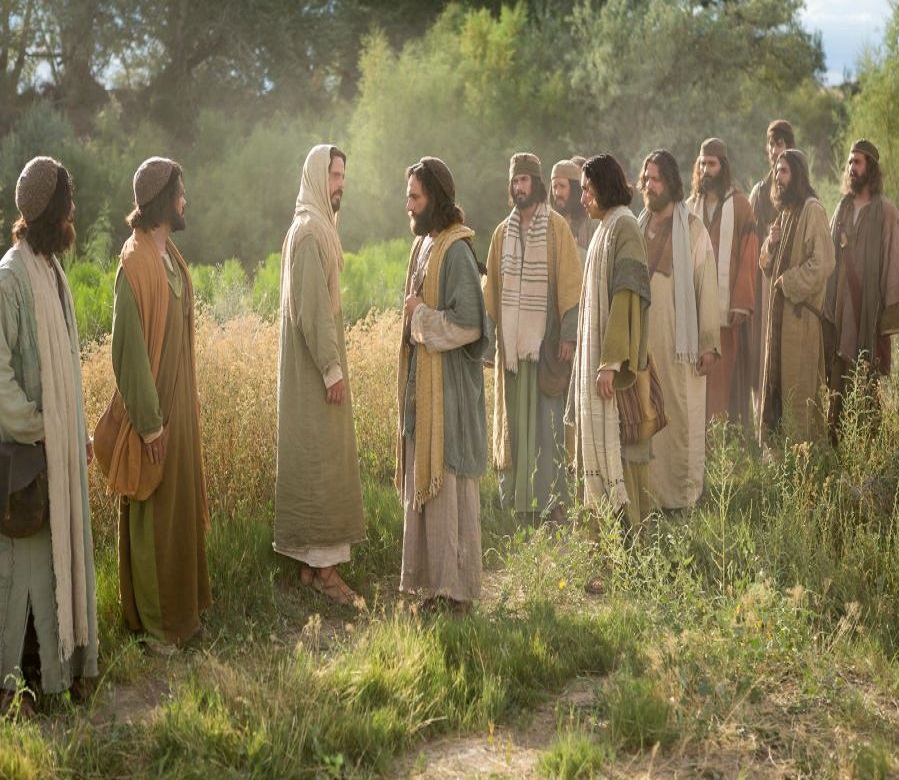
What language did Jesus speak with his disciples?
During his life and public ministry on earth, Jesus communicated with people by teaching them the message of the Kingdom of God through parables. You can learn more about these parables at this link: The best parables of Jesus and their biblical meaning.
Jesus taught the people through comparative, symbolic, reflective, and believable stories so they could understand God's message. But how did Jesus communicate with his disciples? Or, what language did Jesus speak with them?
In this presentation, we will discuss this topic, beginning with the possible languages that Jesus spoke and mastered. We will also identify which language Jesus used with his disciples and with other people.
Also, and way to get a better understanding of the topic, later in this article. There will also be a brief analysis of the historical context in which Jesus moved, especially in relation to place, time, customs and culture.
What languages did Jesus speak?
There is not the slightest doubt that Jesus walked the earth, teaching the word of his Father God and the message of his Kingdom. Likewise, it is known that during his public life, Jesus was accompanied by his twelve disciples.
However, even today there is one aspect of Jesus' life that remains a subject of debate. This issue concerns what language Jesus spoke with his disciples and, in general, with all people while he was on earth.
To give some clarity to this aspect, some historians enlighten us about the possible languages that Jesus could speak. First of all, many historians agree that the Hebrew language was the language spoken by the Jewish leaders, scholars and connoisseurs of the Mosaic Law.
Second, they also agree that the everyday language spoken by Jesus would most likely have been the Aramaic language. Although Jesus must surely have mastered the Hebrew language of his ancestors.
Third, historians think that it is unlikely that Jesus mastered Latin, but a little of the Greek language. And it is that in the times of Jesus the Palestinian territory was a sum of cultures, in which in addition to the Hebrew and Aramaic languages, Latin and Greek were also spoken.
Latin was the language of the Roman population in the territory as the ruling political empire. For its part, Greek, due to commercial activities, was another of the languages spoken by the Palestinian regions.

The languages spoken by the disciples of Jesus
As for the disciples of Jesus, these were Jews, almost all from Galilee and although some of them could dominate some Greek. However, all would surely communicate mostly in Aramaic and, moreover, they were just as fluent in Hebrew as their teacher Jesus.
Having said that, to answer the question, " What language did Jesus speak with his disciples ?" it was most likely Aramaic, the language of their daily communication, but it could also be that they communicated in the language of their ancestors, Hebrew.
But, there is also the opinion of an Israeli teacher or rabbi who expresses that Jesus most likely spoke in Aramaic. And that he also had a very good command of the Hebrew language, because the sacred scriptures were mostly written in that language, and a few other parts were written in Aramaic.
What language did Jesus speak with his disciples and the other people?
This Israeli teacher also adds that, at the time of Jesus, Hebrew was the language spoken among the lower-class population. Perhaps with this information and knowing that these were the type of people that Jesus approached, He probably spoke to the people in Hebrew.
However, most historians, biblical critics and other theological doctrines; They agree that the language that Jesus used the most to communicate may have been Aramaic.
What all these researchers say is that Jesus did not use Latin to express himself. They do believe that Jesus was able to learn some Greek because he spent a large part of his life in the region of Galilee.
Galilee was a territory of great commercial flow and transit of foreigners, mostly Greeks. The Greek language was also an extra-border language of Rome, which was spoken by its civil administrators, as well as in the cities of the Decapolis where the dominant culture was Greek.
For its part, Latin was spoken more than anything else by the political and military personalities of the ruling Roman government at the time of Jesus.

Time when Jesus walked with his disciples
The Lord Jesus Christ was born at a time when the Palestinian territory was under the political domination of the Roman Empire. Rome had established her power in this territory, after the triumphal capture of the city of Jerusalem, 64 years before the birth of Jesus.
General Pompey the Great was the Roman leader to achieve victory in the capture of Jerusalem. This is how, in those times, Rome gave clear manifestos of its conquering power.
Conquering for his vast empire the regions that were all around the Mediterranean basin, namely, and in the west - east - west direction: From Spain to Carthage. Rome had also managed to subjugate and establish dominance over the empire of Greece, making the era of the Hellenistic power of the Greeks disappear.
That said, it is important to see how God chose precisely this time for his Son to be born. A time in which, the place that would see the birth of the Messiah, the envoy of God, a great variety of cultures or civilizations other than the Jewish one developed.
In light of the scriptures, this historical context allows us to better understand the biblical passage from the Gospel of John. As for Jesus coming into a world that was made through him, by him, and for him, but the world did not know him:
John 1:11-14 (PDT): 11 He came into the world that belonged to him, but his own people did not accept him . 12 But to those who did accept him and believed in him, he gave the right to become children of God . 13 They are children of God, not by physical birth, nor by human decision or a husband’s will, but by divine nature. 14 The Word became flesh and made his dwelling among us, full of grace and truth. We have seen his glory, the glory as of the one and only Son from the Father.
Jesus Christ, therefore, is not born in any one time or place. Because, this historical context places us in a time and place that God in his perfect plan had destined for the establishment of his universal people, the church of Jesus Christ.
A universal people that would come to be the fulfillment of God's promise to Abraham:
Genesis 22:17 (NBLA): I will surely bless you and make your descendants as numerous as the stars in the sky and as the sand on the seashore; your descendants will possess the gates of their enemies.
Galatians 3:16 (NBLA): Now the promises were made to Abraham and to his offspring . It does not say, “and to offsprings ,” referring to many, but rather to one : “and your offspring ,” that is , Christ.

Languages at the time of Jesus
In the times of Jesus and in the places where he walked, they also spoke the Semitic languages of the Jews. You could also find other cultures that spoke other languages such as Latin and Greek.
Aramaic:
The Aramaic language was one of the two Semitic languages spoken by the Jews at the time of Jesus. This Aramaic language was closely linked to the Hebrew language; and from it three main periods can be distinguished:
- ancient period: Old Aramaic belongs to the period between the ninth and fourth centuries before the Christian era.
- The Middle Period: This Aramaic language belongs to the period between the third century before the Christian era, up to two hundred years after Christ.
- Late period: This Aramaic is found in the period between two hundred and nine hundred years after Christ.
The Aramaic language of the times of Jesus is that corresponding to the middle period. But at this time two forms of dialects could also be distinguished.
The Aramaic they spoke in Galilee and the one they spoke in the region of Judea, of which Jerusalem was the capital. The Aramaic of Galilee, which was also the language that Jesus spoke with his disciples, was very easy to distinguish.
So much so that the Jews of the region of Judea made fun of the Galileans speaking. Recognizing them immediately by their speech, the evangelist Matthew writes well:
Matthew 26:73 (ESV): Shortly after, those who were there approached Peter and said: - Surely you are one of them too. Even in your way of speaking you can tell.
Hebrew : The other Semitic language spoken primarily by Jewish leaders and interpreters of the law.
Greek : Since the expansion of the Hellenistic empire, this culture, as well as the Greek language, managed to penetrate the different communities and social strata of Jewish civilization. Even more so in Galilee and in Nazareth, the city of Jesus' childhood and youth.
Where the settlers became familiar with the Greek language because of the commercial and administrative transactions of that time.
Place where Jesus walked with his disciples
Jesus walked with his disciples through different regions and cities to carry out his earthly ministry. All these places belonged to the territory of Palestine, located on the eastern perimeter of the Mediterranean basin.
And, as mentioned earlier, it was part of the vast Roman Empire. To help you better understand this territory, I recommend you visit this link: The map of Palestine in the time of Jesus.
In this interesting article an analysis of said territory is made, which makes us understand even more the value of the message and the greatness of the Lord Jesus Christ. In the same way, aspects such as the political organization, theological doctrines, social groups and more of the territory of Palestine for those times are treated.
Today all the places where Jesus walked with his disciples is known as the Holy Land. However, this land is not recognized as a country within the United Nations (UN), it is only considered as a territory, the Palestinian Territory.
Currently, the Palestinian Territory is located in the area known as the Middle East. Although God could choose Rome as the cradle of the birth of the Son of Jesus of him, for being the central and main city of the prosperous modern Roman empire of those times, but he does not do so.
On the contrary, God confuses the world, by choosing a remote domain of the Roman empire to be the place where Jesus would carry out his life and public work.
Belén
The place chosen by God to fulfill the prophecy announced by the prophets, regarding the birth of the Messiah, was the town of Bethlehem:
Micah 5:2 (RVC): You, Bethlehem Ephrathah, though you are small among the clans of Judah, out of you will come for me one who will be ruler over Israel, whose origins are from of old, from ancient times.
Joseph and Mary lived in the city of Nazareth, Galilee region, but they had to move to the town of Bethlehem, their city of origin in the Judea region. This trip happened while Mary was pregnant with Jesus and because of the census ordered by the Emperor of Rome at the time, Augustus Caesar.
All Jews had to be registered in their place of birth and both Joseph and Mary came from Bethlehem. However, after Jesus is born, Joseph and Mary travel with the baby to Jerusalem.
Since the days of the celebration of the Jewish purification festival in the temple were approaching, so they had to purify themselves. In addition, they also had to comply with the Law of Moses, regarding the presentation of the firstborn and offering sacrifice to God in the temple of Jerusalem. After this, Joseph, Mary and the baby return to Nazareth in Galilee:
Luke 2:39 (RVR 1960): After having complied with everything prescribed in the law of the Lord, they returned to Galilee, to their city of Nazareth.

Galilee
Galilee was the place where most of the public life of Jesus took place, the fact that to the east of this region is the Lake of Genesaret, also called the Sea of Galilee. He induced the largest populations in Galilee to develop in the vicinity of the west bank of this great lake.
For being in that area the best part of the arable and fruitful land of Galilee, as well as of all the territory of Palestine. These fruitful lands in Galilee were managed by a few landowners, most of them from Jerusalem.
The rest of the territory of Galilee was populated by a small number of middle-class people, who were merchants and craftsmen. As for the poor class or humble people, they made up the great mass of the population of Galilee.
In general, the people of Galilee were considered by the inhabitants of the other regions of Palestine, as hard-working, quarrelsome and rebellious people to the rule of Rome. Contrary to the Jews of the region of Judea who had settled down and established a mixed government between Rome and the king of Judea, Herod the great.
Galilee land of Gentiles
The great commercial transit of pagan foreigners that occurred in Galilee through the Lake of Genesaret. He caused this region to become known as a territory of gentiles or pagans, that is, non-Jewish people:
Matthew 4:15 (DHH): -Land of Zebulun and Naphtali, beyond the Jordan, by the sea: Galilee, where the Gentiles live.
That is why some disciples of Jesus who were from the city of Bethsaida, on the east bank of the Sea of Galilee. When telling Nathanael, who would also later be a disciple, about Jesus and where he came from, he responded in this way:
John 1:45-46 (DHH): 45 Philip went to find Nathanael and told him, “We have found the one Moses wrote about in the Law, and about whom the prophets also wrote—Jesus of Nazareth, the son of Joseph.” 46 Nathanael asked, “ Can anything good come out of Nazareth ?” Philip replied, “Come and see.”

Nazareth
Nazareth, a city in the Galilee Region in northern Palestine, was the place where Jesus spent his childhood and youth with his parents. That is to say, the part of the private life of the Lord Jesus Christ was lived in this city of Nazareth.
In the city of Nazareth at the time of Jesus, daily life for adults passed between the tasks of the field, housework and religious rites. As for the children, the girls stayed by the side of the adult women of the family, learning their trades.
While the little boys learned the tasks performed by their parents. But the parents had the responsibility to instruct their children about the sacred scriptures, in terms of learning by heart the Jewish liturgies that were prayed in the worship of God in the synagogues.
In rabbinical schools, children were educated in the Jewish culture and learned to read the sacred scriptures in the Hebrew language. There the children orally studied Jewish texts such as: the Torah, the Talmud, the Mishnah and the books of the prophets.
In this way boys and girls were prepared to fulfill their religious obligations in family life, synagogues and in the temple during pilgrimages to Jerusalem. As for writing, it was only taught to a small and select number of male children.
As for the language that was spoken in Nazareth and in general in Galilee among the Jewish settlers, it was the Aramaic language. Because it was the mother tongue with which every Jewish boy or girl was raised, in the same way, among the Jewish communities, their commercial exchanges were all done in the Aramaic language.
Finally, we invite you to continue learning more about the Lord by reading the article " Jesus' Leadership : Characteristics, Contributions, and More."

